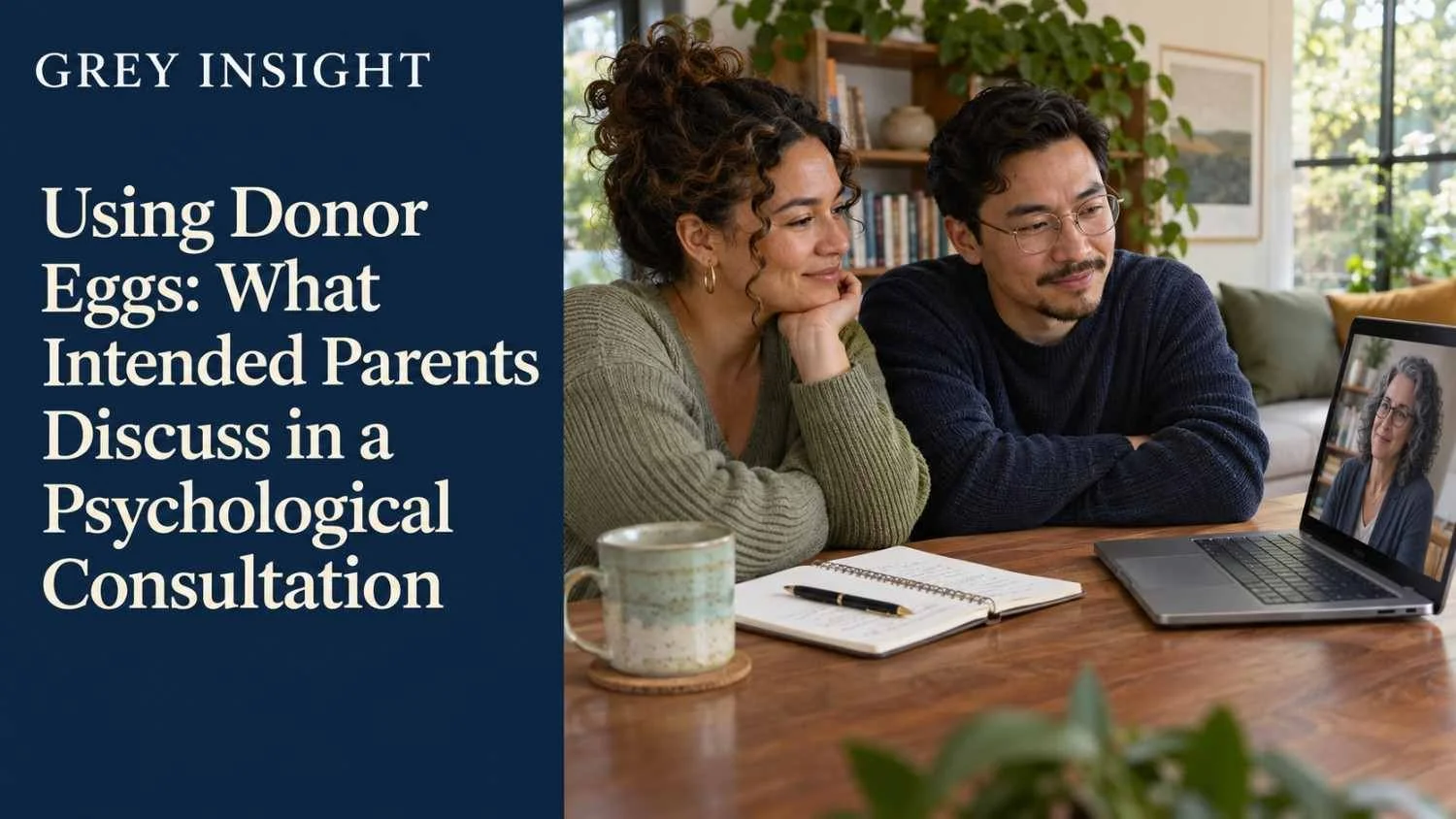
A donor egg psychological consultation gives intended parents structured space to discuss the emotional, relational, and ethical questions involved in donor conception. You may talk about the donor relationship, a future child’s origins, family roles, and how expectations could change. The consultation is not fertility treatment, a guarantee that your clinic will accept documentation, or a promise of pregnancy.
What Is a Donor Egg Psychological Consultation?
For intended parents, this is generally a psychoeducational conversation about building a family with donated eggs. It helps you consider questions that may matter long after a treatment cycle ends.
The American Society for Reproductive Medicine (ASRM) strongly recommends a consultation with a qualified mental-health professional trained in third-party reproduction for people receiving donated eggs, sperm, or embryos. Suggested topics include disclosure, the needs of donor-conceived people, donor relationships, grief when relevant, and future medical information. This is professional guidance; individual clinic requirements can differ. Read ASRM’s donation guidance.
You may hear the meeting called “donor egg counseling,” a “recipient consultation,” or a “psychological consultation.” Ask your clinic what it actually requires. An intended parent’s psychoeducational meeting should not be confused with a donor’s psychological assessment or treated as a test of whether you deserve to parent.
Why Might Your Fertility Clinic Request One?
A clinic may request a consultation so intended parents have time to consider the long-term implications of donor conception and discuss questions that a medical appointment may not fully address. Some clinics also request documentation that a consultation occurred.
Before scheduling, request the clinic’s instructions in writing. Ask who should attend, what qualifications it requires of the professional, whether it needs a consultation summary, who should receive it, and when it is due. Do not assume that another clinic’s process—or an existing therapy relationship—will meet those requirements.
What Will You Discuss About Your Path to Using Donor Eggs?
You may discuss what led you to consider donated eggs, what feels settled, and what still feels uncertain. There is no emotional response you are required to have.
For some people, this path follows fertility treatment or the loss of an expected genetic connection. Others consider donated eggs as part of LGBTQIA+ family building, solo parenthood, or another plan that does not begin with an infertility diagnosis. Relief, grief, excitement, frustration, and ambivalence can coexist—or none of those words may fit.
A consultant may ask how you make decisions, what support you have, and how you might respond if plans change. ASRM includes treatment failure, stopping treatment, and alternative plans among topics that may be relevant. The discussion should make room for your values without pressing you to continue treatment or pursue parenthood at any cost. Read ASRM’s guidance on recipient consultations.
| Discussion topic | Question you might consider | Why it matters |
|---|---|---|
| Donor relationship | What role, if any, do we imagine the donor having? | Expectations can differ among the people involved. |
| Future contact | How might we respond if contact becomes possible or wanted? | Preferences may change over time. |
| Talking with a child | What information can we preserve and share about their origins? | A child may have questions at different ages. |
| Medical-history updates | How could important new information reach our family? | Available health information may change. |
| Genetic relatives | How might we respond to connections through the same donor? | Genetic relationships can become discoverable later. |
| Parenting roles | Who expects to provide care and make decisions? | Genetic, gestational, and caregiving roles may differ. |
| Privacy and extended family | Who may share our family-building information? | Intended parents and relatives may have different boundaries. |
| Changing plans | When will we revisit our expectations? | Decisions made before treatment may need review later. |
These are conversation starters, not a checklist with correct answers.
How Do Directed and Nonidentified Donors Change the Conversation?
A directed donor is identified to the intended parents, often because they already know one another. A nonidentified donor is someone whose identifying information is not initially shared through the arrangement. Neither description tells you everything about future contact.
With a directed donor, the conversation may include existing relationships, expectations for visits or updates, the donor’s own wishes, and how other family members understand the arrangement. ASRM recommends additional discussion for directed donation and, where appropriate, separate conversations with donors and recipients as well as a joint conversation. The donor’s autonomy matters; familiarity does not automatically make someone a co-parent. Read ASRM’s directed-donation guidance.
“Nonidentified” does not promise lifelong anonymity. Consumer DNA testing and online information can reveal genetic connections outside the control of a clinic or family. ASRM recommends the term nonidentified in place of anonymous for that reason. Read ASRM’s donor terminology opinion.
How Might You Talk With a Child About Donor Conception?
A consultation may help you think about how to speak with a future child about their origins in an honest, age-appropriate way. You do not need a perfect script before you begin.
Consider what information you will have, what you can preserve, and how you might respond when a child asks new questions. The donor-conceived person may eventually want to understand their genetic background, available health history, or possible donor connections. Their interests deserve a place in decisions made before they can participate.
ASRM strongly encourages disclosure to donor-conceived people while recognizing that parents make personal decisions about how to communicate. Its ethics guidance also discusses preserving available donor information. Read ASRM’s opinion on informing offspring.
What Family Roles, Contact, and Boundaries Should You Consider?
It helps to name each person’s role rather than assuming everyone means the same thing by “parent,” “donor,” or “family.” An egg donor provides a genetic contribution; an intended parent plans to raise the child; a gestational parent carries a pregnancy. Legal parentage is a separate question.
If a gestational carrier, partner, or directed donor is involved, ask what each person expects about communication and decisions before and after birth. Consider who may share photographs, speak about the donor arrangement, or contact others involved. These conversations should respect the donor’s and gestational carrier’s choices as well as the intended parents’ boundaries.
Legal requirements vary. Bring questions about agreements, parentage, and rights to an appropriately qualified reproductive attorney rather than relying on a psychological consultation for legal conclusions. ASRM’s LGBTQ+ family-building guidance likewise discusses the potential role of legal consultation in third-party reproduction. Read the ASRM guidance.
What Happens If New Medical Information or Genetic Connections Emerge?
A consultation can help you plan how your family might receive and respond to information that becomes available later. It cannot predict what information will emerge.
You might ask your clinic or donor program how it handles updates to donor medical history and what records it retains. You can also consider how to respond if a future child discovers people genetically linked through the same donor. ASRM identifies both possibilities as topics for recipient consultation. Medical questions about screening or the meaning of a health update belong with the fertility team or another appropriate clinician. Read ASRM’s donation guidance.
What If Partners or Family Members Have Different Feelings?
Different feelings do not necessarily mean the plan is wrong. They are a reason to find out what each person understands, needs, and can freely agree to.
One intended parent may want to discuss donor conception openly while another wants more privacy. Relatives may have opinions about genetics or parenting that the intended parents do not share. A consultation can make these differences easier to name without handing decision-making to extended family.
If the disagreement is persistent or connected to earlier experiences, ongoing family-planning therapy may provide more room to work through it. Neither a consultation nor therapy should pressure someone into a family-building choice.
What Happens During the Consultation, and What Documentation May Follow?
The process should begin by clarifying the clinic’s request, who is participating, and what information may be shared afterward. The consultation itself may explore your questions, relationships, expectations, and plans for talking about donor conception.
Grey Insight currently describes an initial contact, a collaborative consultation, and a written summary sent to a nurse, agency, or fertility coordinator as needed. Its page calls the intended-parent meeting a supportive consultation, while some headings use “evaluation” language. Confirm the precise service and documentation required for your arrangement before booking. Review Grey Insight’s donor consultation service.
Ask who will receive any summary, what it will contain, and how consent to share it works. A completed meeting or summary does not guarantee that a particular clinic will accept it. If a separate assessment becomes appropriate, that should be explained as a distinct process.
How Is This Consultation Different From Ongoing Therapy?
A donor egg consultation addresses a defined set of family-building questions and may respond to a clinic’s documentation request. Ongoing therapy follows your personal goals over time and can offer continuing support with grief, identity, anxiety, or relationship patterns.
ASRM describes psychoeducational support and psychotherapy as different parts of fertility counseling. Therapy sessions should not be assumed to fulfill a clinic’s requested consultation. Read ASRM’s fertility-counselor guidance.
If treatment itself has become difficult to carry, Grey Insight’s guide to IVF and fertility treatment stress explains when longer-term support may help.
How Grey Insight Supports Intended Parents Using Donor Eggs
Grey Insight describes its intended-parent donor consultation as structured, nonjudgmental, trauma-informed, and LGBTQIA+-affirming. It includes discussion of the path to donor conception, donor relationships, communication with a child, and future family dynamics. See Grey Insight’s donor consultations.
The practice also offers family-planning and assisted-reproduction therapy for people who want continuing space to explore decisions, identity, grief, or relationships. A consultation cannot promise clinic acceptance, and neither service can promise a pregnancy.
Frequently Asked Questions
-
No. The intended-parent consultation is primarily a psychoeducational discussion, not a test with a parenting grade. You can bring uncertainty or difficult feelings to the conversation. If a clinic has asked for an “evaluation,” request its written instructions so you and the professional understand precisely what it means and whether a different service is required.
-
That depends on your family-building arrangement and your clinic’s instructions. A solo intended parent may attend alone; partners planning to parent may both need to participate. Directed donation can call for additional conversations involving the donor and affected partners. Ask the clinic for its participant requirements before scheduling rather than assuming one format fits every arrangement.
-
A directed donor brings an existing or identifiable relationship into the discussion. You may need to clarify expectations about contact, family roles, privacy, and communication with a future child. The donor’s preferences and autonomy matter too. Depending on the arrangement, separate and joint consultations may be appropriate; your clinic can explain what it requires.
-
There is no single conversation that every family must have in the same way. ASRM strongly encourages informing donor-conceived people about their origins, while recognizing that parents make personal decisions about communication. A consultation can help you consider the future child’s interests, preserve available information, and think about how conversations may develop as they grow. Read ASRM’s ethical guidance.
-
No. A consultation focuses on donor-conception implications and may produce documentation requested by a clinic. Therapy provides continuing support based on your goals. You may want one, the other, or both. If you need a clinic document, obtain its written requirements; attending ordinary therapy does not automatically satisfy them.
-
Grey Insight currently says it prepares a consultation summary for a nurse, agency, or fertility coordinator as needed. Before the meeting, ask what your clinic requires, who will receive the summary, what it may contain, and how you will authorize sharing. The exact document and process should be confirmed for your situation.
Choosing the Right Next Step
If you are unsure which fits, contact Grey Insight with the proposed participants, document recipient, deadline, and clinic instructions. The purpose is a more informed conversation and an appropriate next step, without a promised clinic or reproductive outcome.
