VAWA Psychological Evaluations: Centering Safety, Credibility, and Your Story
A VAWA psychological evaluation is a written clinical assessment used to document the emotional and psychological effects of battery or extreme cruelty in support of a VAWA self-petition. USCIS says VAWA self-petitioners must show a qualifying relationship and other eligibility elements, and USCIS also applies an any credible evidence standard in these cases. That matters because many survivors do not have police reports, hospital records, or other formal documentation of abuse. A strong evaluation does not replace legal evidence, but it can help translate fear, trauma, coercion, and psychological harm into organized clinical documentation that supports your story.
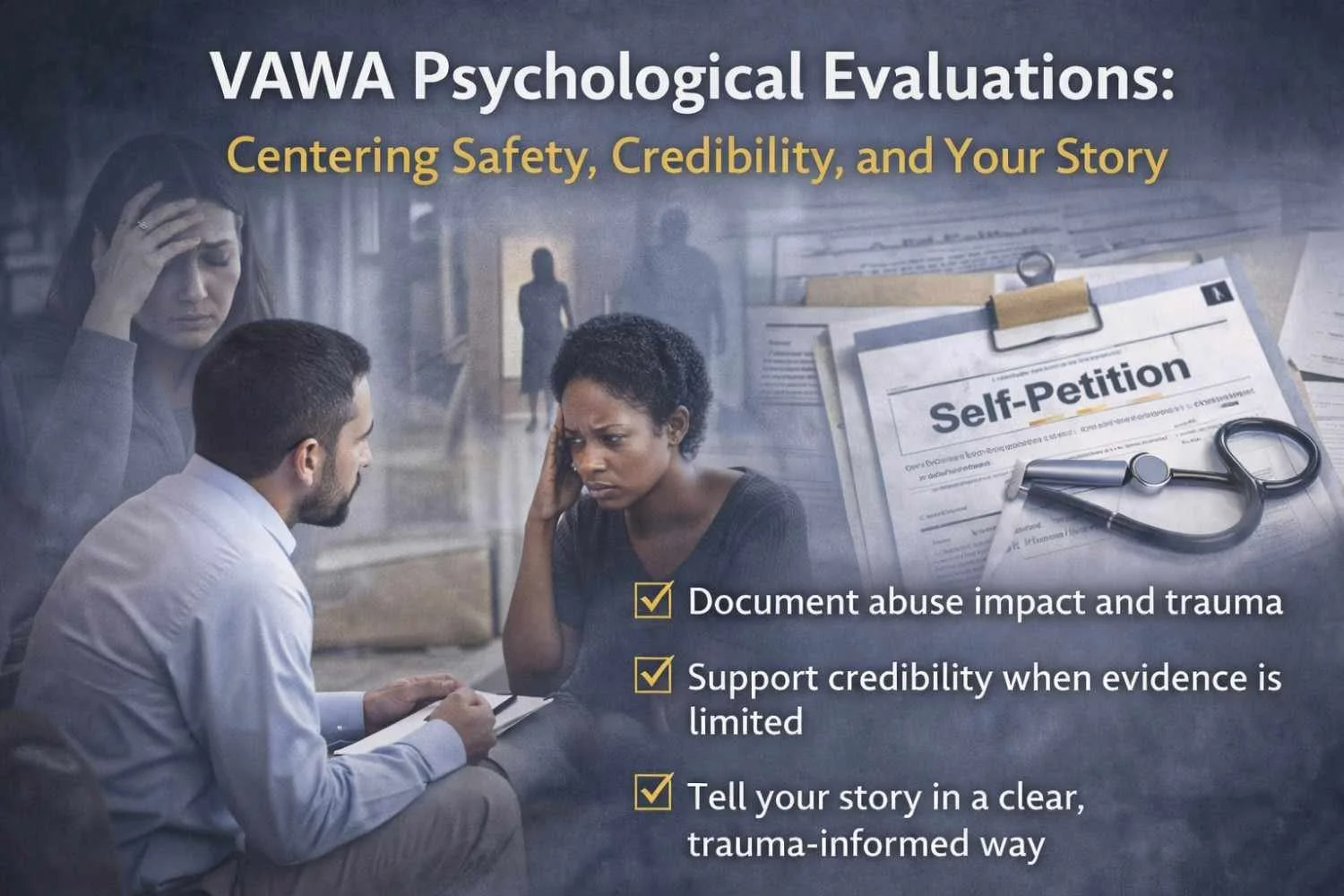
This post is designed as a clear explainer. It covers what a VAWA psychological evaluation is, how it may strengthen a case, what the interview and timeline usually look like, what the report includes, and how Grey Insight’s current immigration-evaluation process fits into that. Grey Insight’s immigration page already lists VAWA among its supported case types and explains its current process, timeline, and fees.
Read more: Boost Confidence Affirmative Therapy
The 60-second answer
A VAWA psychological evaluation is not therapy. It is a clinical-legal support document. Its job is to document how abuse, coercion, fear, trauma, and related mental health symptoms have affected you in ways that matter to the self-petition. It may help show the psychological impact of battery or extreme cruelty, provide clinically organized evidence when formal documentation is limited, and support the credibility and clarity of the overall case. It cannot guarantee approval, and it does not replace legal strategy. Grey Insight’s current page says its standard process includes a consultation, two Zoom interviews of about 1 hour each, and a report in roughly 14 business days, with expedited options available.
Read more: Understanding Affirmative Therapy and Its Impact on Wellness
What USCIS is actually looking for in a VAWA self-petition
At a high level, USCIS says VAWA self-petitioners must show a qualifying relationship to an abusive U.S. citizen or lawful permanent resident, plus other requirements tied to the specific category. USCIS policy materials also make clear that the abuse standard is battery or extreme cruelty, and USCIS’s public VAWA Q&A says the law applies equally to victims of either sex. That matters because many people still assume VAWA is only for women, and that is not how USCIS describes it.
The most important evidence rule for this article is the any credible evidence standard. USCIS says VAWA self-petitioners may submit any credible evidence relevant to eligibility, and USCIS keeps discretion over what weight to give that evidence. That is exactly where a psychological evaluation can become useful: it is not the whole case, but it can be one credible piece of the evidentiary record when abuse-related mental health effects need to be documented clearly.
Read more: Best Practices of Affirmative Therapy
How mental health evidence can strengthen a VAWA case
A psychological evaluation can help document the emotional and mental health effects of abuse in ways that ordinary statements often cannot. That may include PTSD symptoms, panic, anxiety, depression, fear, hypervigilance, sleep disruption, shame, dissociation, and difficulty functioning in daily life. Competitor pages that rank for VAWA evaluations consistently frame the report this way: as a professional document that explains the emotional and psychological consequences of abuse in a form attorneys can use.
It can also matter when the abuse was primarily psychological, coercive, controlling, or isolating rather than visibly physical. USCIS recognizes battery or extreme cruelty, not just injuries captured in a hospital chart. That gives room for mental health evidence to support cases where the survivor’s story involves fear, coercive control, manipulation, degradation, threats, or long-term psychological harm that may not have produced obvious external records.
Read more: How to Know If a Therapist Is Truly Affirming (Not Just “LGBTQ-Friendly”)
| Issue in the case | How psychological evidence may help |
|---|---|
| Emotional abuse or coercive control | Documents fear, anxiety, trauma, and psychological consequences |
| Little or no police/medical evidence | Provides expert clinical evidence when formal documentation is limited |
| PTSD, panic, depression, or anxiety | Shows the mental health impact of battery or extreme cruelty |
| Credibility concerns | Organizes the abuse narrative and psychological effects clearly |
| Prima facie review | Helps present credible evidence of abuse and impact early in the case |
This table matches both USCIS’s evidence framework and the way current provider pages explain the practical value of VAWA evaluations.
Read more: Therapy for OnlyFans and Adult Content Creators: Burnout, Boundaries, and Being Seen
Why evaluations matter when formal evidence is limited
This is one of the biggest reasons people search for this service. Many survivors never called police. Many never went to a hospital. Some were isolated, financially controlled, threatened, ashamed, undocumented, or afraid of retaliation. In those situations, a psychological evaluation does not “make up” missing evidence, but it can document the emotional and psychological impact of abuse in a clinically credible way. PECGNA explicitly positions VAWA evaluations as important when official records are limited, and that framing fits USCIS’s any-credible-evidence approach.
This is also where your H1 theme matters. A good VAWA evaluation should center safety, because survivors are often being asked to describe painful experiences in the context of a legal process. It should center credibility, because the report needs to be organized, careful, and clinically grounded. And it should center your story, because the evaluation is strongest when it documents your lived reality without flattening it into a generic abuse checklist. PECGNA’s page does a decent job of stressing structure and compassion; Grey Insight can improve on that by making the trauma-informed framing even clearer.
Read more: Managing Jealousy in Polyamory: A Therapist’s Tools You Can Practice at Home
What happens during a VAWA psychological evaluation
The process usually begins with a consultation or intake. That first step is often used to understand the case type, confirm fit, discuss timing, and explain what the evaluation will cover. After that, the core of the process is one or more structured clinical interviews focused on the abuse history, relationship context, current symptoms, functioning, safety concerns, and psychological impact. Providers ranking for this query generally describe the process as interview-based, trauma-informed, and oriented toward producing a final report for the legal case.
Grey Insight’s current immigration evaluation page gives a more concrete version of that structure. It says the process starts with a consultation, then moves into two interviews of about 1 hour each conducted over Zoom, followed by a report in roughly 14 business days once the interviews are complete. That specificity is useful because “timeline” and “what to expect” are major parts of the search intent for this topic.
Read more: Polyamory-Friendly Couples Therapy: What Actually Happens in Session
| Step | What happens | Typical timing |
|---|---|---|
| Consultation | Intake or scheduling call to understand case and confirm fit | Before the interview |
| Interview phase | One or more structured clinical interviews | Often 2–3 total hours, sometimes split |
| Record review | Review of legal, medical, or mental health records if available | During or after interviews |
| Report writing | Clinician drafts the final report | Often 1–3 weeks depending on provider |
| Delivery | Final report shared with client and/or attorney | After final review |
This table blends the common competitor structure with Grey Insight’s published process details. PECGNA describes a structured evaluation followed by a written report for the survivor’s attorney, and Polaris describes an intake, additional interviews as needed, and delivery of a draft within three weeks of the final interview.
Read more: Healing Sexual Shame and Purity Culture Through Kink-Affirming Therapy
What the final report usually includes
A strong VAWA report usually includes background information, the relationship context, the abuse or coercion narrative, current symptoms, clinical observations, and diagnostic impressions when appropriate. It should also explain how the findings relate to the legal issue, rather than simply listing symptoms. PECGNA says the written report summarizes the survivor’s experiences, explains the emotional and psychological consequences of the abuse, and offers professional findings. That is the right basic model.
A good report should do more than say “this person is distressed.” It should help the reader understand how the abuse affected functioning, why the mental health impact is clinically significant, and how that impact fits the legal narrative. That is the difference between a generic letter and a useful evaluation. Grey Insight’s own legal implications of immigration psychological evaluations post already frames evaluations as evidence that can influence asylum, deportation, and visa-related decisions when handled accurately and thoroughly.
Read more: Is My Kink Trauma or Desire? A Therapist’s Framework
| Question | Grey Insight’s current process |
|---|---|
| How are sessions done? | Zoom |
| How many interviews? | Two interviews |
| About how long? | About 1 hour each |
| Standard turnaround? | Roughly 14 business days |
| Expedited options? | 7 days, 5 days, or 48 hours for additional fee |
| Current listed fee | $1,350 |
These details come from Grey Insight’s current immigration evaluation page and are worth surfacing because they answer exactly the questions many prospective clients ask before booking.
Read more: Dating, Disclosure, and Double Lives: A Therapist’s Guide for Sex Workers
What a good evaluation experience should feel like
This part matters more than many competitor pages admit. A VAWA evaluation may require talking about violence, coercion, fear, threats, humiliation, or prolonged control. That means the process should feel clear, respectful, and trauma-informed. It may still be emotionally difficult, but it should not feel rushed, chaotic, or needlessly interrogative. PECGNA explicitly describes the evaluation as trauma-informed and culturally sensitive, and Grey Insight’s service page emphasizes minimizing re-traumatization and conveying the client’s experience with precision and empathy.
Grey Insight also has a trust advantage here because Dr. Michael Grey lists immigration-evaluation training on his background page, including immigration psychological evaluation training and Asylum Medicine Evaluations – Asylum Medicine Training Initiative (AMTI). Even though that specific training is not VAWA-specific, it strengthens the overall credibility of the immigration-evaluation side of the practice.
Read more: Religious Trauma and Queer Identity: How Affirmative Therapy Helps You Heal
What a VAWA psychological evaluation cannot do
This is important for trust. A VAWA psychological evaluation cannot guarantee approval. It cannot replace legal strategy, and it cannot create facts that are not there. USCIS still decides what weight to give any submitted evidence, even under the any-credible-evidence rule. Grey Insight’s immigration page is already appropriately careful on this point: it presents evaluations as support for the application, not as a promise of outcome.
That honesty matters for AI SEO too. Search engines and users are more likely to trust content that explains both the value and the limits of the evaluation.
Read more: Protecting Your Nervous System in a Stigmatizing World: Nervous System Hacks for Sex Workers
How Grey Insight can help
At Grey Insight, the strongest positioning is not “we help you win.” It is: we provide trauma-informed, clinically organized psychological evaluations that help document your story safely and clearly. Grey Insight’s current immigration page explicitly includes VAWA among the supported case types, explains the process, lists the fee and expedited options, and emphasizes accurate reporting, telling your story, trauma-informed care, and LGBTQ+ affirming care. Those are meaningful differentiators for this topic.
FAQs
-
A VAWA psychological evaluation is a written clinical assessment that documents the emotional and psychological effects of abuse in support of a VAWA self-petition.
-
It can document trauma, fear, anxiety, depression, PTSD symptoms, and the broader mental health impact of battery or extreme cruelty in a way that supports the petition.
-
Yes. USCIS says VAWA self-petitioners may submit any credible evidence relevant to eligibility, and USCIS decides the weight to give that evidence.
-
That is one reason psychological evaluations can matter. Provider guides explicitly note that these evaluations can be especially helpful when formal documentation is limited.
-
No. USCIS’s own VAWA Q&A says the law applies equally to victims of either sex.
-
USCIS uses that legal standard in VAWA cases, and official materials indicate the abuse can include more than visible physical injury. Provider-side VAWA evaluation pages commonly address emotional, psychological, and coercive harm as part of the evaluation context.
-
No. It is a legal-support assessment, though it should still be handled in a trauma-informed manner.
-
Many providers describe around 2–3 total interview hours. Grey Insight currently says two one-hour interviews and about 14 business days for the report after interviews are complete.
-
No. It is supporting evidence, not a guarantee. Grey Insight’s immigration page is careful about that.
-
A trauma-informed evaluation should allow space for difficult emotions without turning the process into a hostile or shaming interview.