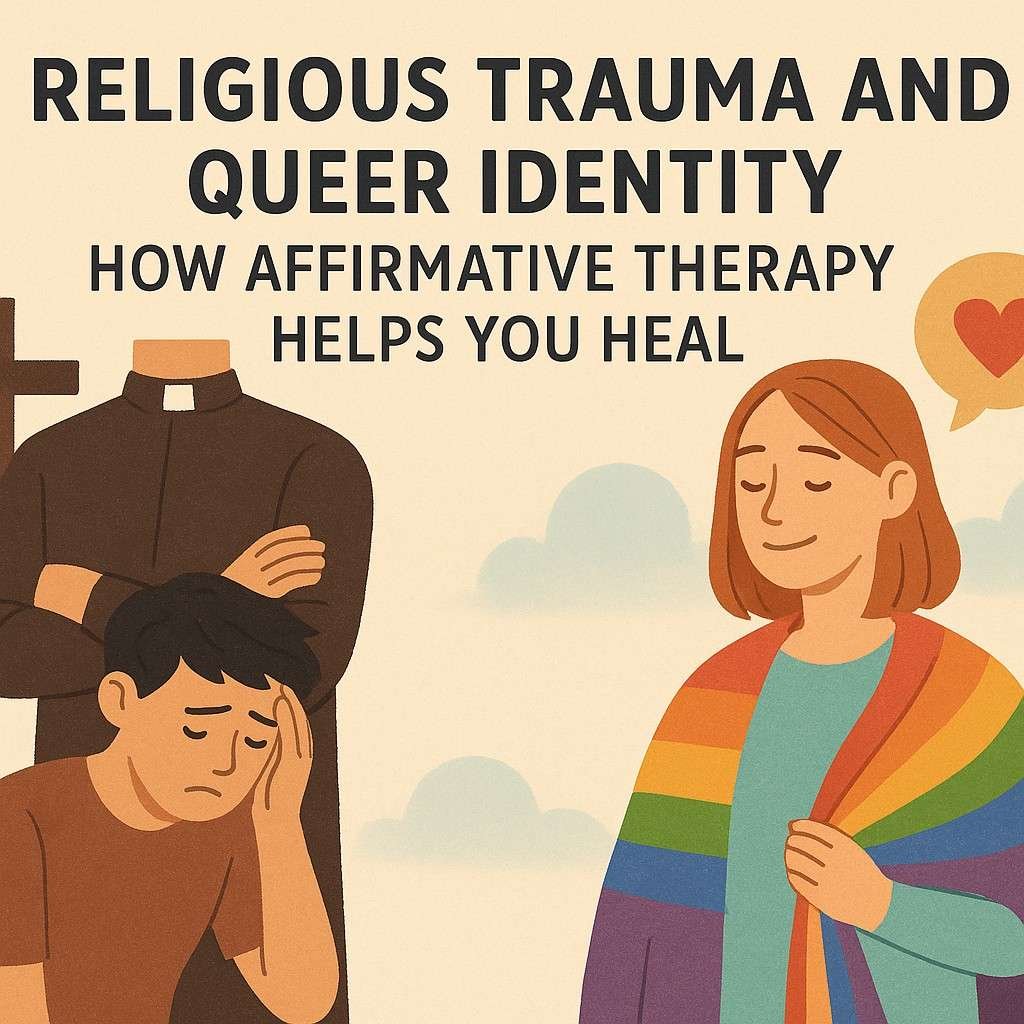
Religious trauma is the harm caused by coercive, shaming, or spiritually abusive contexts—including scripture-as-control, forced conformity, and threats tied to identity. For queer people, the damage is amplified by minority stress (rejection, concealment, internalized stigma). Affirmative therapy heals by validating identity, integrating minority stress into the case plan, and adapting evidence-based methods (CBT/ACT/EMDR) to your faith, culture, and safety needs. Below: a precise definition, symptom checklist, how treatment changes, a consult script to vet providers, and how to start with Grey Insight.
Read more: What to Expect in an Affirmative Therapy Session
What “religious trauma” means (and what it doesn’t)
Working definition: Religious or spiritual abuse is a pattern of manipulation, coercion, control, or betrayal of trust in a religious context (e.g., misusing doctrine to shame, restrict, or isolate). It can produce anxiety, shame, intrusive guilt, and identity conflict.
Important scope note: “Religious Trauma Syndrome” isn’t a DSM/ICD diagnosis. Clinicians treat the effects using established trauma and minority-stress frameworks rather than inventing a new diagnosis.
Why it hits LGBTQ+ clients harder: Minority stress processes—rejection expectations, concealment, internalized stigma—are well documented drivers of distress for sexual and gender minorities. When religious control overlaps with these pressures, symptoms intensify.
Read more: Understanding Affirmative Therapy and Its Impact on Wellness
Common impacts for queer clients (use this as a self-check)
Hyper-vigilance around “rule-breaking,” scrupulosity-like rumination, and shame spirals
Panic or shutdown responses when encountering faith language, family events, or worship spaces
Isolation and loss of community after coming out (or after being outed)
Relationship strain (fear of rejection, difficulty setting boundaries with family or leaders)
Suicidality risk when family/community rejection escalates—family acceptance is protective and should be part of care planning when safe to do so.
Read more: Exploring Safe Spaces Through Affirmative Therapy
Why affirmative therapy heals differently (vs. “neutral” therapy)
Neutral care often sidelines identity (“we don’t need labels”) and frames faith conflict as a private failing. Affirmative therapy takes a different stance:
Identity-positive: Your labels, pronouns, and relationships (including CNM/poly, kink) are valid clinical context—never “the problem.”
Minority-stress aware: Stigma is modeled as a core driver of distress in the case formulation and addressed directly.
Faith-integrating: If you wish, therapy includes values-aligned faith exploration without coercion—healing doesn’t require abandoning belief.
Consent-forward & power-literate: Language, exercises, and disclosures are collaborative; bias and power are named, including in institutions you move through.
Read more: Affirmative Therapy in Irvine: Embrace Your Authenticity
Evidence check: what works for LGBTQ+ clients
Affirmative CBT reduces depression/anxiety and minority-stress processes in randomized and controlled trials (e.g., ESTEEM; affirmative CBT pilots and implementations). Telehealth and group formats show feasibility and acceptability.
Conversion efforts (SOCE) are harmful and unsupported. Major bodies (APA, SAMHSA) oppose SOCE; affirmation—not “change”—improves mental health. If you endured “church counseling” or retreats aimed at changing orientation or gender, therapy should address trauma, grief, boundaries, and rebuilding support.
Read more: Exploring the Benefits of Affirmative Therapy for All Clients
How treatment actually changes under an affirmative lens
CBT (Cognitive Behavioral Therapy)
Thought records explicitly reference minority-stress triggers (misgendering at church, family pressure, scripture-as-shame).
Exposures/behavioral experiments target avoidance rooted in coercive religious experiences (e.g., tolerating value-aligned rituals vs. trauma reminders), not generic “face your fear.”
Cognitive restructuring distinguishes belief from coercion, reduces “shoulds,” and replaces moralized self-talk with values-consistent language.
ACT (Acceptance & Commitment Therapy)
Values clarify your faith stance (stay, leave, or redefine) and committed actions honor safety and authenticity.
Defusion skills target internalized stigma and inherited perfectionism; self-as-context reduces shame.
EMDR/Trauma work
Targets include spiritual abuse scenes, punitive teachings used as control, or community shunning.
Resourcing includes chosen-family imagery, grounding tied to affirming spaces, and safety plans for real-world exposures (holidays, services).
Harm reduction & stabilization
Substance goals are client-led (safer use, cutback, abstinence); safety planning covers digital privacy and doxxing risks when relevant.
Family work (when safe)
Integrate Family Acceptance Project practices to increase protective behaviors and reduce risk, without forcing “harmony” over safety.
Read more: How Affirmative Therapy Creates Safe Spaces for Healing
If you faced conversion attempts (“church therapy,” camps, or retreats)
Expect your therapist to state a clear anti-SOCE stance and to name likely sequelae: shame, relational distrust, trauma reminders, and identity confusion.
Treatment focuses on grief (lost years, lost community), boundary-setting, reclaiming agency, and building or finding affirming spiritual communities if you want to remain in faith.
Read more: Affirmative Therapy for LGBTQ+ Mental Health Support
Finding a church trauma therapist who’s truly affirming (not just “friendly”)
Green flags
Uses your name/pronouns correctly; offers to update records
Names minority stress as central to the case plan
Can explain how CBT/ACT/EMDR change for religious-shame triggers
States a clear anti-conversion stance; can discuss spiritual abuse precisely
Explains privacy (HIPAA platform, psychotherapy notes protections, options for confidential communications) in plain language
Clarifies licensure for where you are physically located during telehealth (and mentions PSYPACT if applicable)
Red flags
“We don’t need labels” or “family harmony first” over your safety
Equates faith struggle with pathology; moralizes queer identity
Vague on privacy/records; dodges licensure specifics
Read more: Why Affirmative Therapy is the Future of Mental Health Treatment
12-item consult script (Strong vs Weak answers)
Ask these on a free consult; pick the provider with the most “Strong” responses.
How do you define religious or spiritual abuse clinically?
Strong: Uses precise, non-pathologizing language (coercion, control, misuse of doctrine).What LGBTQ-affirming training/supervision have you completed recently?
Strong: Lists specific courses/supervision and how practice changed.How do you integrate minority stress into case formulation?
Strong: Gives concrete examples tied to your triggers.How do CBT/ACT/EMDR adapt for faith-based shame or coercion?
Strong: Describes method changes and safety scaffolding. PubMeWhat’s your stance on conversion efforts (SOCE)?
Strong: Clear opposition; references APA/SAMHSA guidance.Can therapy support me staying in or finding an affirming faith community?
Strong: Values-led, no coercion either way.How do you protect privacy (platform, psychotherapy notes, EOB)?
Strong: HIPAA-compliant platform; explains special protections for psychotherapy notes; offers confidential communications.Are you licensed to see me where I’m located today?
Strong: States license(s), verifies your location each visit; may cite PSYPACT for psychologists.What does Month 1 look like (assessment → goals → skills)?
Strong: Clear structure and pacing.How will we measure progress?
Strong: Concrete indicators (sleep, avoidance, intrusive guilt, social reconnection, safety).How do you involve family safely?
Strong: Draws on Family Acceptance Project practices when appropriate.If you’re not the right fit, will you refer me?
Strong: Yes—fit-first, referral-friendly.
Read more: The Role of Identity in Affirmative Therapy Sessions
Healing while staying connected to faith (if you choose)
Affirmative therapy doesn’t force you to leave belief or community. Options include:
Boundary-setting with family/congregation while you recover
Finding affirming congregations or queer-led fellowships
Creating secular rituals for meaning, grief, and celebration
The goal is values-alignment and safety, not conformity.
Read more: How Affirmative Therapy in Irvine Supports Mental Health
What to expect from privacy and telehealth (quick answers)
Psychotherapy notes receive extra protections under HIPAA and are usually kept separate from the medical record; ask how your provider handles them.
Telehealth is state-based: your clinician must be licensed where you are physically located during session; some psychologists use PSYPACT to practice across participating states.
Read more: Affirmative Therapy for Gender and Sexual Expression
Why work with Grey Insight
Explicitly affirming across LGBTQIA+, religion-related harm, CNM/Poly, Kink/BDSM, and sex-work contexts—no moralizing, no pathologizing.
Evidence-informed care adapted to your context (CBT/ACT/EMDR), delivered via secure telehealth across CA, CO, AZ, FL, ID, NV, VA & VT.
Privacy clarity from day one (HIPAA platform, psychotherapy-note practices, confidential communications).
Fit-first policy: If we’re not ideal for your goals, we’ll help you find an affirming match.
CTA: Book My Free Consultation (15 minutes). Bring the consult script—we’ll earn the green flags.
Read more: How Affirmative Therapy Builds Safe Healing Spaces
-
No. Clinicians treat the effects using established trauma and minority-stress frameworks; “religious trauma syndrome” isn’t in the DSM/ICD.
-
It validates identity, centers minority stress, and adapts methods (CBT/ACT/EMDR) to your beliefs and safety—without coercion to leave or stay.
-
Yes. Major health agencies (APA, SAMHSA) oppose SOCE as ineffective and harmful; affirmation is linked with better mental health.
-
Yes—ask about HIPAA platform, psychotherapy notes, and confirm the clinician is licensed where you are (or uses PSYPACT where applicable).
-
When safe, family acceptance behaviors reduce risk and improve outcomes; your therapist can coach supportive actions.
