Asylum Psychological Evaluations: How Mental Health Evidence Strengthens Your Case
An asylum psychological evaluation is a written clinical assessment that documents the mental health effects of persecution, abuse, torture, fear, trauma, or other psychological harm relevant to an asylum claim. It does not replace legal evidence, but it can strengthen a case by translating emotional and psychological impact into organized clinical documentation. USCIS materials make clear that asylum applicants should provide corroborating evidence where available, and USCIS guidance also recognizes that trauma can affect memory, testimony, and the way an applicant presents emotionally.
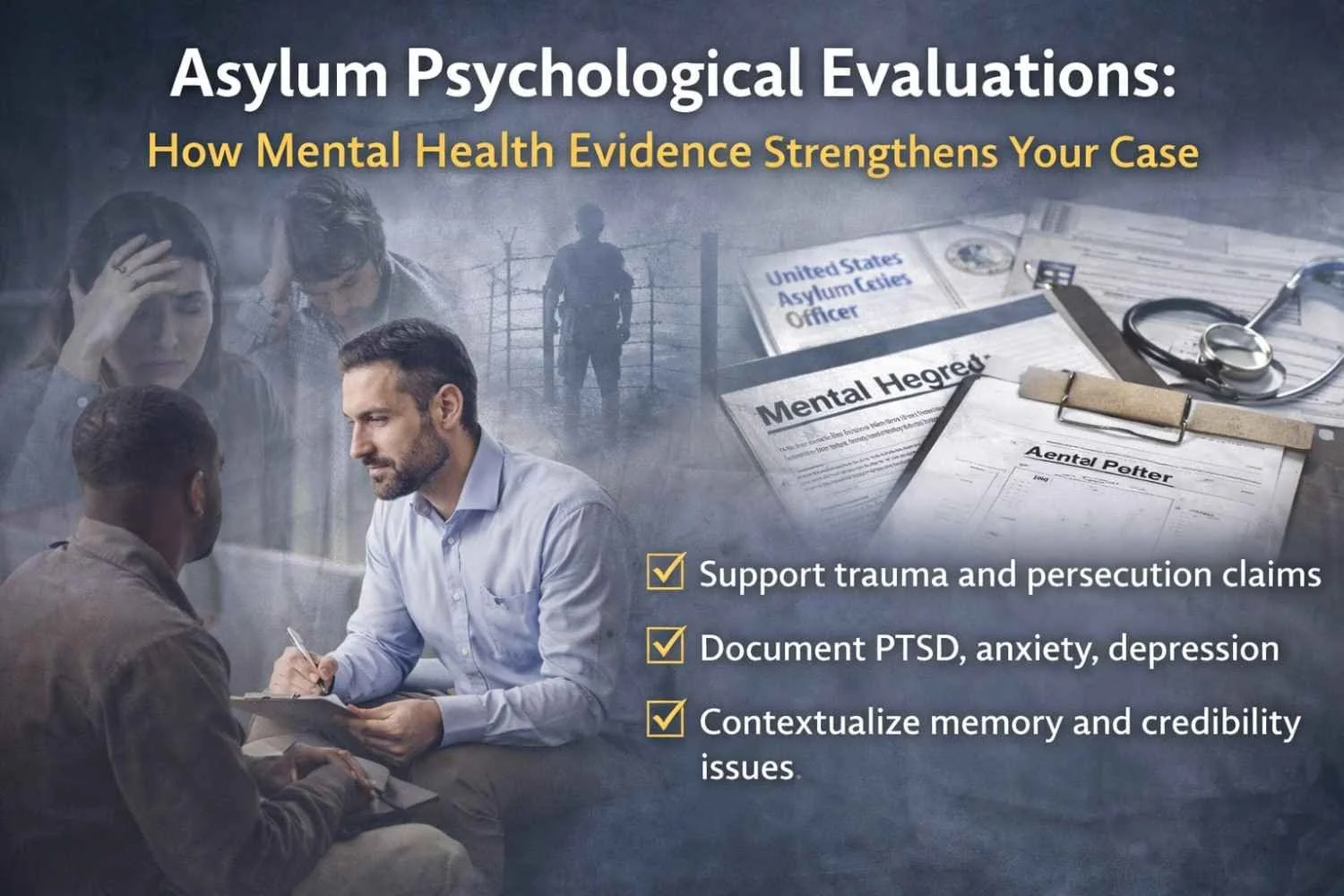
That matters because asylum cases are often built around personal testimony, fear of return, and events that may not always be supported by police reports, hospital records, or other formal documentation. A strong psychological evaluation can help explain what happened, how it affected mental health, and why certain trauma-related symptoms may matter in the legal context. Grey Insight already offers immigration psychological evaluations that include asylum cases, so this article should function as the educational explainer that supports that service page.
Read more: Boost Confidence Affirmative Therapy
The 60-second answer
An asylum psychological evaluation is a clinical evaluation, not therapy. It is usually used as supporting evidence to document trauma-related symptoms, fear, emotional harm, and psychological functioning in relation to an asylum claim. A good report can help explain PTSD, anxiety, depression, panic, dissociation, memory disruption, or other trauma effects in a way that supports the legal narrative. It does not guarantee approval, and it does not replace legal strategy, but it can strengthen the case when used appropriately. USCIS guidance for asylum-related issues and hardship-related evidence both support the use of mental health documentation where relevant.
Read more: Understanding Affirmative Therapy and Its Impact on Wellness
What mental health evidence can document in an asylum case
Mental health evidence can help document the psychological effects of persecution, torture, abuse, trafficking, family violence, political violence, or fear of return. In many asylum cases, the evaluation is used to show the clinical impact of what the person experienced rather than simply restating the events. That may include symptoms of PTSD, anxiety, depression, panic, hypervigilance, nightmares, dissociation, emotional numbing, grief, shame, or impaired daily functioning. Competitor provider pages consistently describe asylum evaluations this way, and USCIS materials support the broader idea that expert documentation can help explain trauma-related effects.
A psychological evaluation can also help explain why someone’s story may not come out in a perfectly linear way. Trauma can affect recall, emotional expression, and disclosure. USCIS training materials specifically recognize that trauma may affect memory and the way an applicant tells their story, which makes a trauma-informed clinical report especially useful in cases where the person appears inconsistent, flat, fearful, or fragmented under stress.
Read more: Best Practices of Affirmative Therapy
Why psychological evidence can matter when documentary evidence is limited
One reason asylum psychological evaluations matter is that many asylum seekers do not have complete documentary proof from their home countries. They may not have police reports, medical records, or other official documents that clearly show what happened. A psychological evaluation does not invent facts, but it can provide expert documentation of trauma’s psychological effects and help connect the person’s symptoms to their account of persecution or abuse. That is exactly how many top-ranking provider pages explain the value of these evaluations, and it matches how they are used in practice.
There is also broader evidence that forensic medical and psychological evaluations can matter in immigration relief outcomes. A large Physicians for Human Rights study reported that applicants who obtained forensic medical evaluations through the PHR network had positive outcomes in 81.6 percent of known cases, compared with a 42.4 percent national asylum grant rate during the same period. That does not prove causation in every case, but it does show why carefully prepared expert evidence can matter.
Read more: How to Know If a Therapist Is Truly Affirming (Not Just “LGBTQ-Friendly”)
| Issue in the case | How psychological evidence may help |
|---|---|
| Trauma after persecution or torture | Documents PTSD, anxiety, depression, panic, or trauma-related symptoms |
| Fear of return | Explains ongoing psychological impact and fear-based functioning |
| Flat affect, memory gaps, delayed disclosure | Provides trauma-informed context for symptoms that may affect testimony |
| Limited formal documentation | Offers expert clinical evidence when other corroboration is incomplete |
| Delayed filing | May help document mental health effects relevant to extraordinary-circumstances arguments |
This table reflects the strongest overlap between official USCIS guidance, trauma-informed asylum practice, and the way current provider pages explain the role of psychological evidence.
Read more: Therapy for OnlyFans and Adult Content Creators: Burnout, Boundaries, and Being Seen
What happens during an asylum psychological evaluation
The process usually begins with a consultation or intake to confirm the case type, timeline, and fit. After that, the main part of the evaluation is one or more structured clinical interviews. The evaluator may ask about family background, country-of-origin context, abuse, persecution, trafficking, threats, detention, trauma history, current symptoms, emotional functioning, and fear of return. If relevant documents are available, the evaluator may also review legal filings, medical records, therapy records, school records, or affidavits. This process is consistently described across competing provider pages and Grey Insight’s own immigration evaluation materials.
The evaluation should be structured, but it should not feel like a hostile interrogation. A strong evaluator is trying to gather clinically relevant information and connect it to the asylum claim in a way that is clear, accurate, and trauma-informed. Grey Insight’s immigration evaluation page already emphasizes a trauma-informed approach, which is a meaningful differentiator because many readers searching this topic are also worried about whether they will be treated with care.
Read more: Managing Jealousy in Polyamory: A Therapist’s Tools You Can Practice at Home
How long does the process usually take
There are two different timing questions here: interview time and report turnaround.
For the interview itself, many providers describe asylum or immigration evaluations as taking roughly two to three total hours, sometimes in one session and sometimes split into multiple sessions. For report turnaround, providers vary more. Some describe one to three weeks, while others cite longer timelines depending on scheduling and case volume. Grey Insight currently states that its immigration evaluation process includes two interviews of about one hour each and a report in roughly 14 business days, with expedited options available.
There is also useful evidence supporting remote evaluation formats. One peer-reviewed study reported that telephonic and in-person asylum psychiatric evaluations produced affidavits of equivalent quality, which helps support the legitimacy of remote formats when handled properly.
Read more: Polyamory-Friendly Couples Therapy: What Actually Happens in Session
| Step | What happens | Typical timing |
|---|---|---|
| Consultation | Intake or scheduling call to understand case and confirm fit | Before the interview |
| Interview phase | One or more structured clinical interviews | Often 2–3 total hours, sometimes split |
| Record review | Review of legal, medical, or mental health records if available | During or after interviews |
| Report writing | Clinician drafts the final report | Often 1–3 weeks depending on provider |
| Delivery | Final report shared with client and/or attorney | After final review |
This table is useful because it answers the exact “process” and “timeline” search intent that drives many visits to asylum-evaluation pages.
Read more: Healing Sexual Shame and Purity Culture Through Kink-Affirming Therapy
What the final report usually includes
A strong asylum psychological evaluation report usually includes the applicant’s background, relevant persecution or trauma history, current symptoms, clinical observations, diagnostic impressions when appropriate, and an explanation of how the findings relate to the asylum claim. Competitor pages repeatedly describe those as core report elements, and Grey Insight’s own immigration-evaluation content reinforces the importance of accuracy and thoroughness in legal cases.
The most useful reports do not just say that someone is distressed. They explain the nature of the distress, how it fits clinically, and why those findings matter to the legal question.
Read more: Is My Kink Trauma or Desire? A Therapist’s Framework
Can an asylum evaluation help with delayed filing issues
Sometimes, yes. USCIS guidance says extraordinary circumstances related to the one-year filing deadline may include serious illness or mental or physical disability, including effects of persecution or violent harm. That means a mental health evaluation may sometimes help document why filing was delayed, if the attorney believes that issue is legally relevant in the case. This is an important section because many competitor pages skip it, even though it directly matches real search intent.
This should be framed carefully. An evaluation does not automatically solve a one-year deadline issue. It may, however, provide clinically grounded support if trauma or mental health effects genuinely affected the person’s ability to file sooner.
Read more: Dating, Disclosure, and Double Lives: A Therapist’s Guide for Sex Workers
What a good asylum evaluation experience should feel like
A good asylum evaluation should feel clear, respectful, and trauma-informed. It may still be emotionally difficult, because people are often talking about persecution, abuse, threats, detention, trafficking, or fear of return. But it should not feel rushed, shaming, chaotic, or needlessly aggressive. This is where Grey Insight can stand out. The current service page emphasizes a trauma-informed approach, and Dr. Michael Grey’s training page specifically lists Asylum Medicine Training Initiative training, which adds a meaningful trust signal for this type of work.
Read more: Religious Trauma and Queer Identity: How Affirmative Therapy Helps You Heal
What an evaluation cannot do
This section matters for trust. An asylum psychological evaluation cannot guarantee case approval. It cannot replace legal representation, and it cannot manufacture facts that are not there. It works best as one part of a broader evidentiary strategy. Grey Insight’s own immigration evaluation page states that the evaluator is not responsible for the outcome of legal proceedings, which is exactly the kind of honest framing that builds credibility.
Read more: Protecting Your Nervous System in a Stigmatizing World: Nervous System Hacks for Sex Workers
How Grey Insight can help
Grey Insight already offers [immigration psychological evaluations] on its site, and the current service page specifically includes asylum as a supported case type. It states that evaluations are trauma-informed, conducted by Zoom, and usually involve two one-hour interviews followed by a report in roughly 14 business days. Dr. Michael Grey’s training page also lists Asylum Medicine Evaluations through the Asylum Medicine Training Initiative, along with other immigration-evaluation training. Those details make Grey Insight well positioned to publish on this topic with real authority instead of generic mental-health language.
-
It is a written clinical assessment that documents the mental health effects of persecution, abuse, torture, fear, or trauma in support of an asylum claim.
-
It can document trauma-related symptoms, explain emotional and functional impact, and provide expert clinical evidence that supports the applicant’s narrative.
-
It can help contextualize trauma-related memory problems, flat affect, delayed disclosure, or fragmented recall, which USCIS training materials recognize may occur in trauma survivors.
-
No. It is a clinical evaluation used for legal-support purposes, even though it should still be handled in a trauma-informed way.
-
Interview time is often around two to three total hours, and report turnaround varies by provider. Grey Insight currently says roughly 14 business days after the interview phase.
-
Yes. Evidence and current provider practice support remote formats, and Grey Insight’s current immigration evaluation process is conducted by Zoom.
-
Usually background history, trauma narrative, symptoms, clinical impressions or diagnosis when appropriate, and explanation of how the findings relate to the asylum claim.
-
Sometimes. USCIS says extraordinary circumstances may include serious illness or mental or physical disability, including effects of persecution or violent harm.
-
Not always, but evaluations are usually most useful when aligned with legal strategy.
-
No. It is supporting evidence, not a guarantee. Grey Insight states this clearly in its immigration evaluation information.
-
Because Grey Insight already offers asylum-supporting immigration evaluations, and Dr. Michael Grey’s training page lists Asylum Medicine Training Initiative training along with other immigration-evaluation training.
-
That is common. A trauma-informed evaluation should allow space for difficulty without turning the process into a hostile interview.