BDSM-Friendly Couples Therapy: Consent, Agreements, Conflict, and Repair
BDSM-friendly couples therapy helps partners talk about consent, agreements, power exchange, boundaries, conflict, aftercare, and repair without treating kink as the problem. A kink-aware therapist should not assume BDSM is unhealthy, caused by trauma, or something the couple needs to stop. Instead, therapy should help partners clarify what is consensual, what is negotiated, what feels safe, what needs repair, and how desire can exist alongside respect and emotional safety. At Grey Insight, BDSM & Kink Therapy supports adults who want affirming, nonjudgmental care around kink, shame, trauma, relationships, and sexual expression.
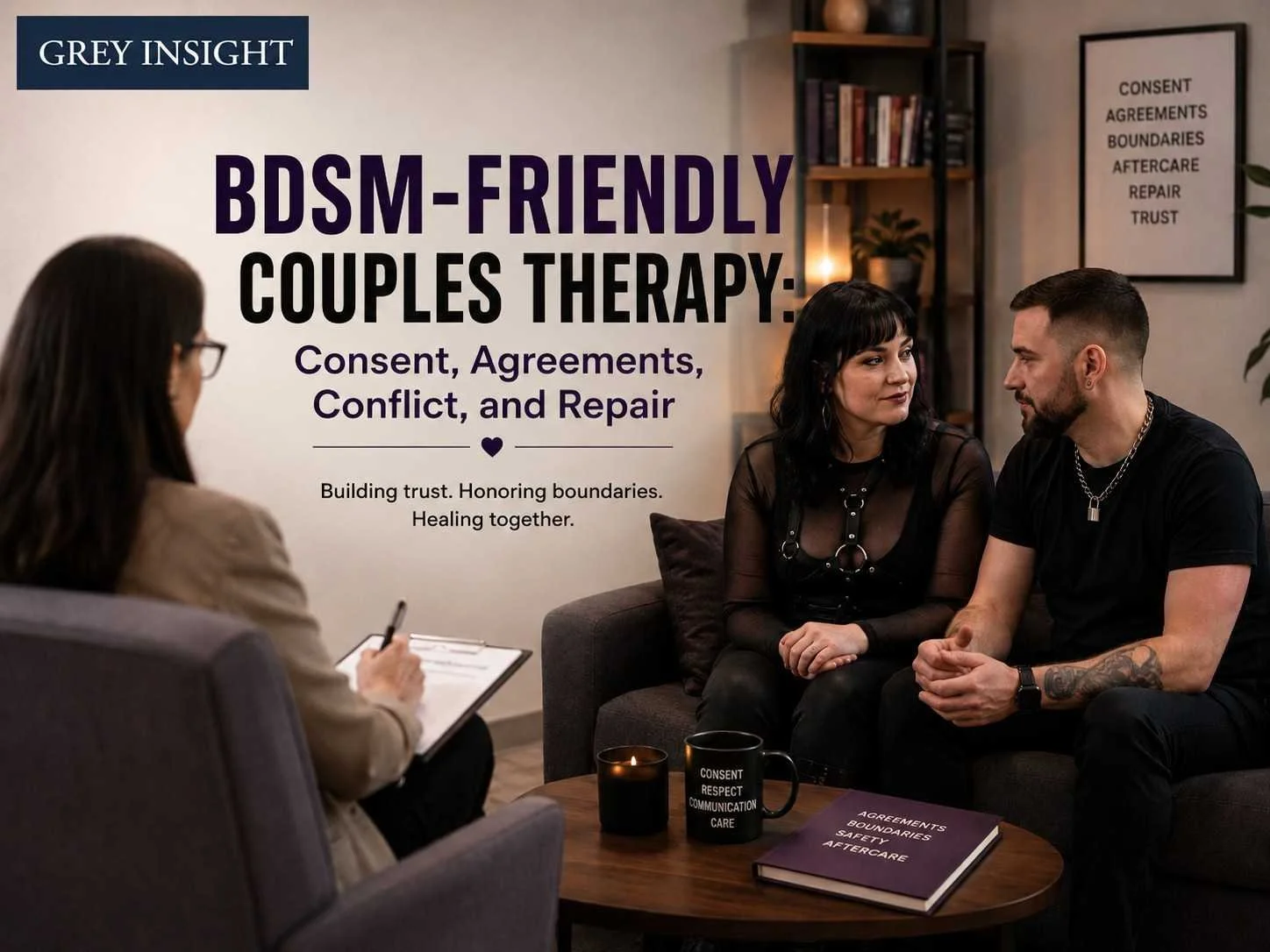
For many couples, the hardest part is not the kink itself. It is the fear of being misunderstood. One partner may worry a therapist will judge them. Another may worry they will be pressured into something they do not want. Both partners may need help talking about desire, limits, emotional impact, privacy, or repair after a difficult experience.
Good BDSM-friendly couples therapy does not sensationalize the relationship. It slows the conversation down, separates consent from pressure, separates shame from values, and helps partners create agreements they can actually live by.
What Is BDSM-Friendly Couples Therapy?
BDSM-friendly couples therapy is relationship therapy for partners who want to discuss kink, BDSM, dominance/submission, power exchange, role dynamics, sexual shame, consent, boundaries, or repair in a nonjudgmental clinical space.
According to theSociety for the Advancement of Psychotherapy’s introduction to BDSM for psychotherapists, BDSM can refer to bondage and discipline, dominance and submission, or sadism and masochism between consenting adults. The same source notes that BDSM may be a practice, lifestyle, orientation, or subculture, and that many people engage in BDSM practices without necessarily using the BDSM label.
The purpose of BDSM-friendly couples therapy is not to decide whether kink is acceptable. It is to help partners understand what is consensual, what is desired, what is avoided, what is assumed, and what needs clearer communication.
A strong therapist does not make kink the automatic explanation for every relationship problem. Sometimes the issue is communication. Sometimes it is shame. Sometimes it is a consent rupture. Sometimes it is a mismatch in desire. Sometimes the kink is not the problem at all.
What Makes Therapy BDSM-Friendly or Kink-Affirming?
A therapist being “open-minded” is not enough. Kink-affirming therapy requires clinical skill, direct language, and the ability to discuss consent, power, safety, shame, and boundaries without moralizing.
If you are preparing to bring kink into the therapy room, Grey Insight’s guide onhow to talk about BDSM in therapy can help you understand what a non-pathologizing, consent-centered therapy conversation should look like.
| BDSM-Friendly Therapy Should… | Why It Matters |
|---|---|
| Treat kink as context, not pathology | Avoids making BDSM the automatic explanation for every issue |
| Ask about consent and agreements directly | Keeps safety and clarity central |
| Discuss power exchange without judgment | Allows partners to talk honestly about roles and needs |
| Separate fantasy, play, and real-life conflict | Prevents misunderstandings |
| Explore shame without moralizing | Helps partners reduce secrecy and self-attack |
| Name trauma carefully | Avoids assuming kink is caused by trauma |
| Support repair after ruptures | Turns conflict into accountable change |
According to the Clinical Guidelines for Working with Clients Involved in Kink, kink-competent care requires clinicians to understand kink-related identities, practices, stigma, consent, and clinical bias. In other words, affirming therapy is not just a tolerant attitude. It is a clinical skill.
Consent Is More Than a One-Time Yes
In BDSM-friendly couples therapy, consent should not be treated as a single yes/no moment. Consent includes negotiation before, check-ins during, and aftercare or repair afterward.
Consent may involve:
What each partner wants
What each partner does not want
What is off-limits
What needs to pause
What words, signals, or pauses mean
What privacy rules apply
What aftercare is needed
What should happen if something feels wrong afterward
According to Sexual Consent Across Diverse Behaviors and Contexts, sexual consent includes both internal willingness and external communication. That matters in BDSM-friendly couples therapy because partners may need help understanding not only whether someone said yes, but whether the agreement was clear, mutual, informed, and still active in the moment.
The Society for the Advancement of Psychotherapy also notes that BDSM participants may negotiate boundaries, limits, sensitivities, and aftercare before play. This supports a key clinical point: consent-centered relationships require more than assumption. They require clarity, communication, and the ability to pause or renegotiate.
This matters because partners may use the same word, “consent,” but mean different things. One partner may think consent was clear because a past agreement existed. Another may feel that the agreement did not cover what happened. Therapy can help identify where communication, assumption, pressure, fear, or repair broke down.
Agreements, Boundaries, and Rules Are Not the Same
Many relationship conflicts become worse because partners use “agreement,” “boundary,” and “rule” as if they mean the same thing. They do not.
| Term | What It Means | Example |
|---|---|---|
| Agreement | A shared commitment both partners consent to | “We check in after intense scenes.” |
| Boundary | A personal limit about what someone will or will not participate in | “I will not continue if my safeword or pause is ignored.” |
| Rule | A directive about what someone else can or cannot do | “You are not allowed to want that.” |
| Repair plan | What happens when harm, confusion, or rupture occurs | “We pause, debrief, apologize where needed, and renegotiate.” |
Couples often run into trouble when rules are called boundaries, assumptions are called agreements, and repair is expected without a clear process.
This is especially important when shame is present. A partner might say “I have a boundary” when what they really mean is “I feel scared.” Another might say “We agreed” when the other partner felt pressured or unclear. Therapy can help slow down those differences without making either partner wrong for having needs.
If shame, purity culture, religious messages, or fear of desire is part of the relationship, Grey Insight’s article on Healing Sexual Shame and Purity Culture Through Kink-Affirming Therapy may be useful.
Common Issues BDSM-Friendly Couples Therapy Can Help With
Mismatched Desire or Kink Interest
One partner may want to explore BDSM while the other feels unsure, curious, worried, or uninterested. Therapy should not pressure either partner. The goal is not to make both people want the same thing. The goal is to help partners talk honestly about desire, fear, limits, consent, and compatibility.
Shame Around Kink
Shame may come from religion, family, culture, past partners, internalized stigma, or fear of being “too much.” Therapy can help partners separate consensual desire from self-attack.
According to the Society for the Advancement of Psychotherapy, clinicians should be careful not to assume that a client’s treatment goals include changing BDSM or poly desires, and should not try to “cure” clients of BDSM or poly desires.
If one or both partners are asking whether desire is rooted in trauma, shame, curiosity, or something else, Grey Insight’s guide Is My Kink Trauma or Desire? can help frame that question without pathologizing kink.
Power Exchange Misunderstandings
Power exchange requires clarity. Problems often happen when one partner assumes the dynamic continues outside agreed moments, or when roles are not clearly negotiated.
Therapy can help partners ask:
When does the dynamic apply?
When does it stop?
Who can pause it?
What happens during conflict?
What happens when one person feels pressured?
What parts are fantasy, and what parts affect daily life?
Conflict After a Scene or Dynamic
Sometimes an experience can go technically “right” but emotionally feel complicated afterward. One partner may feel exposed, ashamed, disconnected, hurt, confused, or unexpectedly vulnerable. Therapy can help partners debrief what happened and identify whether the issue is consent, aftercare, trauma activation, unmet expectations, or repair.
Aftercare Differences
Aftercare may include reassurance, quiet time, physical comfort, food, space, emotional processing, grounding, or a next-day check-in. One partner may want closeness while the other needs silence. One may need reassurance while the other assumes everything is fine.
Therapy can help partners make aftercare specific instead of guessing.
Kink, Trauma, and Body Responses
Kink may intersect with trauma, but one should not automatically be assumed to cause the other. A kink-aware therapist should help distinguish desire, fear, memory, consent, and nervous-system activation.
If trauma responses, body memory, dissociation, shame, or past relational harm are part of the couple’s concern, Trauma Therapy may also be relevant.
CNM, Kink, and Relationship Agreements
Some couples combine kink with consensual non-monogamy, polyamory, or play with others. This requires especially clear agreements around safer sex, privacy, disclosure, jealousy, time, and repair.
If kink overlaps with open relationships, polyamory, throuples, or polycules, Grey Insight’s Consensual Non-Monogamy & Polyamorous Affirming Therapy may also be a strong fit.
What Healthy Repair Can Look Like After Conflict
Repair is not the same as reassurance. Repair requires accountability, changed agreements, and enough emotional safety to try again only if both partners consent.
| Repair Need | What It May Require |
|---|---|
| Consent confusion | Clarify what was agreed, assumed, missed, or misunderstood |
| Emotional rupture | Validate impact before explaining intent |
| Boundary concern | Re-state the boundary and decide what changes going forward |
| Aftercare mismatch | Build a more specific aftercare plan |
| Shame spiral | Slow down self-attack and reconnect to values |
| Trust injury | Use accountability, changed behavior, and time |
| Safety concern | Pause the dynamic until safety is restored |
A consent rupture does not always mean the same thing as abuse, but it does need to be taken seriously. The Society for the Advancement of Psychotherapy notes that clinicians should not automatically assume abuse in BDSM relationships, while also recognizing that abuse can occur and may be harder to disclose because BDSM communities are stigmatized.
A consent rupture does not always mean the same thing as abuse, but it does need to be taken seriously. The Society for the Advancement of Psychotherapy notes that clinicians should not automatically assume abuse in BDSM relationships, while also recognizing that abuse can occur and may be harder to disclose because BDSM communities are stigmatized.
Healthy repair asks:
What happened?
What did each person understand at the time?
Where was consent unclear?
Where did pressure, fear, or assumption enter?
What impact needs to be validated?
What changes before this dynamic continues?
Does either partner need to pause, stop, or renegotiate?
What a BDSM-Friendly Therapist Should Not Do
BDSM-friendly therapy is not “anything goes.” It should be affirming and clinically grounded at the same time.
| A Therapist Should Not… | A Better Approach |
|---|---|
| Assume BDSM is the problem | Ask how consent, communication, and safety are working |
| Treat kink as trauma by default | Explore trauma carefully without pathologizing desire |
| Push one partner to participate | Protect consent and nonparticipation |
| Avoid talking about sex | Discuss sex clinically and respectfully |
| Shame fantasy or desire | Separate fantasy, behavior, consent, and values |
| Ignore power dynamics | Ask how power is negotiated, limited, and repaired |
| Treat boundaries as control | Clarify the difference between limits, agreements, and rules |
According to Sexual Consent Norms in a Sexually Diverse Sample, consent norms can vary across sexually diverse groups, including people who practice BDSM. This reinforces why therapists should avoid one-size-fits-all assumptions and should ask clear, respectful questions about how partners communicate consent, limits, and agreements.
If you are trying to assess whether a provider can work with kink, CNM, LGBTQIA+ identity, or sex-work contexts respectfully, Grey Insight’s guide on how to know if a therapist is truly affirming can help.
How to Prepare for a BDSM-Friendly Couples Therapy Session
You do not need to describe every sexual detail to get help. Good preparation means identifying what the therapy needs to address.
Before the first session, consider:
What does each partner want help with?
Is the issue consent, desire, shame, conflict, aftercare, repair, or communication?
What agreements currently exist?
Which agreements are explicit?
Which agreements are assumed?
Which boundaries feel unclear or crossed?
What does each partner not want to discuss in detail?
What aftercare needs are known?
What aftercare needs are guessed?
Has there been a consent rupture or emotional rupture?
Is trauma being activated?
Is one partner feeling pressured?
Is one partner afraid of being judged?
Does kink overlap with CNM, polyamory, or other partners?
What would repair actually look like?
What should the therapist know about privacy and documentation?
Bring examples, not accusations. “I felt unsafe when we did not pause after I asked to slow down” is more useful than “You never care about my boundaries.”
If kink, BDSM, power exchange, shame, consent, or aftercare is creating tension in your relationship, Grey Insight offers BDSM & Kink Therapy in a nonjudgmental, clinically grounded space. You can book a consultation with Grey Insight to explore support that does not pathologize your desire or ignore consent.
Why Choose Grey Insight for BDSM-Friendly Couples Therapy?
Grey Insight offers affirming therapy for BDSM and kink communities, with support around shame, guilt, trauma, sexual expression, relationships, boundaries, and consent. The goal is not to push partners toward a specific kind of sex or relationship. The goal is to help partners talk clearly, reduce shame, clarify agreements, repair conflict, and make choices from consent instead of fear.
Grey Insight may be a strong fit if your relationship needs help with:
Kink-related communication
Consent and boundaries
Power exchange clarity
Mismatched desire
Sexual shame
Aftercare needs
Repair after conflict
Trauma responses
CNM/polyamory overlap
Privacy and disclosure concerns
BDSM-friendly couples therapy should help partners clarify consent, strengthen agreements, talk through conflict, and repair ruptures without shame. If your relationship needs kink-aware, affirming support, contact Grey Insight to schedule a consultation.
Related Reading from Grey Insight
FAQs About BDSM-Friendly Couples Therapy
-
BDSM-friendly couples therapy is relationship therapy for partners who want to discuss kink, BDSM, power exchange, consent, agreements, conflict, aftercare, shame, or repair in a nonjudgmental clinical space.
-
No. A BDSM-friendly therapist should be nonjudgmental, but still clinically serious about consent, safety, boundaries, emotional impact, and repair. Affirming care does not mean ignoring harm or pressure.
-
Yes. Therapy can help partners discuss mismatched desire without pressure, shame, or avoidance. The goal is consent-based clarity, not forcing either partner to participate.
-
Therapy can explore trauma carefully without assuming kink is caused by trauma. The key is distinguishing desire, fear, memory, consent, and nervous-system activation.
-
Aftercare is the emotional, physical, or relational support partners may need after intense sexual, kink, or power-exchange experiences. It may include reassurance, quiet time, touch, food, conversation, grounding, or space.
-
Yes. Therapy may help partners clarify what happened, validate impact, identify where communication or agreements failed, and decide what repair or safety changes are needed.
-
Ask whether they have experience with kink/BDSM clients, how they distinguish kink from pathology, how they handle consent and privacy, and whether they can discuss sex without shame or sensationalism.
-
You can contact Grey Insight to schedule a consultation and discuss whether BDSM & Kink Therapy or related relationship support is appropriate for your situation.