Adult Content Creator Mental Health: Shame, Isolation, and Privacy Stress
Adult content creator mental health is often shaped by more than ordinary work stress. Shame, isolation, privacy fears, fan-boundary erosion, platform pressure, and the split between online persona and offline life can all affect how safe, connected, and regulated someone feels. Therapy should not assume adult content creation is automatically the problem or push quitting as the default solution. At Grey Insight,Therapy for Sex Work & Adult Content Creators helps creators work with stigma, burnout, boundaries, privacy stress, relationships, and shame without moralizing the work.
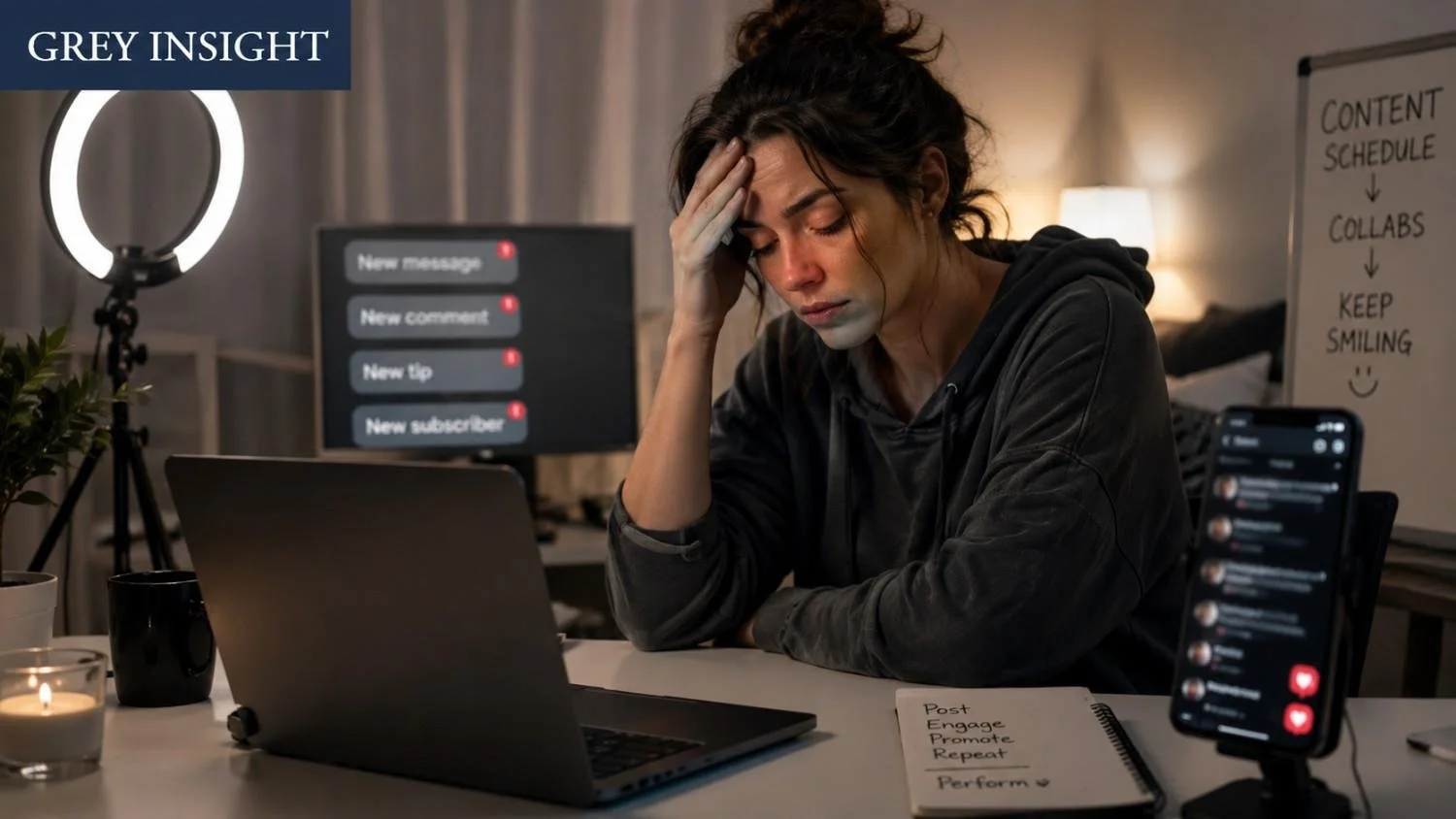
Adult content creation can be work, performance, income, identity, experimentation, survival, creativity, or some mix of those things. For some people, it is empowering. For others, it becomes emotionally complicated. For many, it is both.
The problem is not that every adult creator is damaged or secretly unhappy. That frame is too simplistic and too judgmental. The more accurate question is: what mental-health load does this kind of work create, and what support helps someone stay connected to themselves while doing it?
Why Adult Content Creator Mental Health Is Different From Generic Creator Burnout
Digital creators often deal with audience pressure, income instability, constant posting expectations, algorithm changes, and the feeling that they must always be available. According to Harvard T.H. Chan School of Public Health, digital content creators report high rates of anxiety, depression, and burnout, with pressure tied to financial demands, performance metrics, and content responsibilities.
Adult content creators may carry all of that plus additional layers:
Sexual stigma
Exposure risk
Fan access and entitlement
Platform instability
Payment or account shutdown concerns
Family, employer, or community discovery fears
Relationship disclosure decisions
Safety planning
Shame after posting, messaging, or performing
Pressure to maintain a sexualized persona for income
That makes adult creator burnout different from generic creator fatigue. It is not just “too much screen time.” It can be the exhaustion of managing visibility, desire, risk, privacy, stigma, income, and identity at the same time.
Grey Insight’s guide toTherapy for OnlyFans and Adult Content Creators frames this clearly: adult creators may need support for burnout recovery, fan-boundary erosion, shame, privacy fears, disclosure decisions, trauma responses, and relationship strain without assuming the work itself is automatically the source of every symptom.
Shame: When Stigma Starts Sounding Like Your Own Voice
Shame is not just feeling embarrassed. Shame is the feeling that something about you must be hidden, defended, split off, or explained before you can be accepted.
For adult content creators, shame may come from many places:
Family messages
Religious messages
Cultural stigma
Partner judgment
Workplace risk
Online harassment
Past trauma
Fear of being recognized
Fear of being reduced to the content you create
Internal conflict between public persona and private self
According to research on sex workers’ experiences of stigma and discrimination, perceived stigma from mental health professionals can affect whether sex workers seek mental-health support in the future. The study also found that sex workers reported concerning levels of stigma and discrimination in mental-health settings.
That matters because shame does not only happen inside a person. It is often built through repeated exposure to judgment, secrecy, threat, and misunderstanding. Over time, outside stigma can start sounding like an internal voice:
“What if this is all I am?”
“What if no one would respect me if they knew?”
“What if my therapist judges me?”
“What if I can never have a normal relationship?”
“What if I deserve to be treated this way?”
Asex-worker-affirming therapist should not make you defend the legitimacy of your work before helping you with your actual concerns. The therapy room should be a place where shame can be examined, not reinforced.
Isolation: Why Attention From Fans Is Not the Same as Support
Adult creators may receive constant messages and still feel deeply alone.
That can be confusing. From the outside, it may look like the creator has nonstop attention, admiration, and interaction. But fan attention is not the same as emotional support. Paid attention is not the same as being known. Audience engagement is not the same as being able to tell the truth.
Isolation can show up when:
You cannot tell friends or family what you do.
You hide parts of your income or schedule.
You feel “on” for fans but invisible offline.
You have many interactions but few safe relationships.
You worry a partner will judge, control, or misunderstand the work.
You split your life into public persona and private self.
You feel wanted as an image but unseen as a person.
This is one of the core mental-health pressures of adult content creation: the creator may be highly visible and deeply hidden at the same time.
Isolation is not always about being physically alone. Sometimes it is the exhaustion of constantly calculating who gets to know which version of you.
Privacy Stress: Why Exposure Risk Can Keep the Nervous System on Alert
Privacy stress is the constant background calculation of what could be found, shared, leaked, screenshotted, recognized, or misunderstood.
For adult creators, privacy stress may involve:
Doxxing fears
Screenshots or reposted content
Being recognized offline
Family discovery
Employer discovery
Platform data concerns
Banking or payment issues
Keeping separate accounts, emails, phones, or names
Fear that intimate content could be used against you
According to a technical research agenda on safer digital intimacy, people who engage in digital intimacy, including sex workers and people who create or share intimate content, face significant security and privacy risks, and stigma can intensify those risks. The paper names concerns such as deplatforming, outing, context collapse, and content theft.
This means privacy stress is not paranoia. It is a realistic nervous-system load in a stigmatizing digital environment.
When the body has to keep scanning for risk, it can become hard to fully rest. You may find yourself checking accounts, searching your name, reviewing privacy settings, monitoring fan behavior, or replaying what could go wrong. Grey Insight’s article onprotecting your nervous system in a stigmatizing world may be especially relevant when privacy fear starts to feel like constant threat monitoring.
Boundary Erosion: When Fans Expect Constant Access
Adult creator burnout is not only about how many hours someone works. It is also about the kind of access the work can demand.
Fans may expect quick replies, custom content, emotional availability, flirtation, reassurance, exclusivity, personal details, or the feeling of special closeness. Even when creators set prices and limits, the emotional labor can build.
| Pressure | What It Can Feel Like | What Therapy Can Help With |
|---|---|---|
| Constant messages | “I’m never off.” | Response windows and access rules |
| Custom requests | “I have to be available to earn.” | Consent, pricing, and refusal scripts |
| Parasocial intensity | “Fans think they know me.” | Persona boundaries and emotional distance |
| Platform algorithms | “If I disappear, income drops.” | Sustainable pacing and workload reality |
| Shame after posting | “I feel exposed after I log off.” | Decompression and self-worth repair |
| Privacy fear | “Any mistake could expose me.” | Practical privacy planning and regulation tools |
Boundary erosion can become especially hard when income depends on responsiveness. “Just set boundaries” is not enough if a creator is also worried about rent, visibility, chargebacks, subscriber loss, or platform punishment.
Therapy can help by making boundaries specific, practical, and connected to the creator’s real life.
What Adult Creator Burnout Can Look Like
Adult creator burnout can look different from standard workplace burnout because the work often involves the body, persona, privacy, sexuality, attention, and identity.
| What’s Happening | What It May Feel Like |
|---|---|
| Emotional labor overload | Irritability, numbness, dread before logging on |
| Persona fatigue | Feeling split between online self and offline self |
| Privacy hypervigilance | Constantly checking what could expose you |
| Shame spiral | Self-attack after posting or interacting |
| Boundary erosion | Feeling guilty for not replying |
| Relationship strain | Hiding, explaining, or defending the work |
| Body disconnection | Feeling like your body or image is not fully yours |
| Platform dependence | Feeling unable to rest without losing income |
Burnout may also affect sleep, focus, intimacy, mood, substance use, and the ability to feel present offline. For some people, the work itself still feels aligned, but the structure around the work no longer feels sustainable.
That distinction matters. The therapy goal may not be “quit.” The goal may be to reduce overload, rebuild boundaries, process shame, protect privacy, and reconnect with parts of life that are not governed by the platform.
What Therapy Should and Should Not Do
Adult-content-creator-affirming therapy is not therapy that avoids hard conversations. It can still address trauma, avoidance, substance use, unsafe patterns, relationship conflict, and burnout. The difference is that it does not begin from judgment.
| Therapy Should Not… | Therapy Should… |
|---|---|
| Assume the work is the problem | Understand work as context |
| Push quitting as the default goal | Support the client’s actual goals |
| Treat disclosure like confession | Treat disclosure as privacy and safety work |
| Moralize sex or content creation | Work clinically with shame, boundaries, and consent |
| Ignore platform and privacy stress | Include digital safety and exposure anxiety |
| Make the client educate the therapist | Bring sex-worker/adult-creator competence into the room |
A policy report on access to mental-health services for people who sell sex found that fear of being judged, fear of being treated as if sex work were the main problem, and fear of being recorded as a sex worker can deter people from fully using therapy or support services.
This is exactly why affirming care matters. A creator should not have to spend the first half of therapy proving that they deserve to be treated as a whole person.
Practical Ways to Protect Your Mental Health as an Adult Creator
These steps are not a substitute for therapy, but they can reduce overload and make your work life more sustainable.
Create transition rituals
Have a clear way to move from “creator mode” back into private life. This might include changing clothes, showering, turning off work devices, leaving the room, journaling, walking, stretching, or doing something ordinary and grounding.
Set response windows
Constant availability trains fans to expect constant access. Response windows help separate work time from recovery time.
Separate work and personal accounts when possible
Use different emails, usernames, devices, payment systems, or communication channels where realistic. Privacy planning is not fear-based. It is a protective infrastructure.
Write refusal scripts before you need them
It is easier to hold boundaries when you are not writing them under pressure. Prepare scripts for custom requests, discount requests, emotional overreach, personal questions, and repeat boundary-pushing.
Build support that is not audience-based
Choose at least one person or professional space where you do not have to perform. This might be a therapist, trusted friend, peer support space, partner, or community group.
Track burnout early
Do not wait until you feel numb, resentful, or unsafe. Warning signs may include dread before logging on, irritability with fans, dissociation during work, shame after posting, or inability to rest.
Make privacy rules before a crisis
Decide what you will share, what you will not share, what accounts are connected, what names you use, and what you would do if something were exposed.
Watch substance-use coping
Some creators use alcohol, cannabis, stimulants, or other substances to work, perform, relax, recover, numb shame, or sleep. That does not mean you are bad. It means coping may need attention. Grey Insight’s Substance Abuse therapy page may be relevant if substance use is becoming part of the work-recovery cycle.
When Therapy May Help
Therapy may help if adult content creation has started affecting how you feel about your body, relationships, safety, identity, or future.
Consider support if:
Shame spirals are frequent.
Privacy fear controls daily decisions.
You feel isolated even with constant fan interaction.
Boundaries feel impossible to maintain.
Your work persona feels hard to turn off.
Relationships are strained by secrecy, disclosure, or judgment.
Substance use has become part of working or recovering.
You feel emotionally numb, detached, or disconnected from your body.
Past trauma is being activated by current work stress.
You are unsure whether you want to continue, pause, change, or leave the work.
If past experiences, objectification, body memory, or sexual trauma are part of what feels activated, Trauma Therapy may also be relevant. If kink, desire, sexual expression, or shame around sexual interests is part of the picture, BDSM & Kink may be a helpful related service.
If shame, privacy stress, fan-boundary erosion, or isolation is starting to affect your daily life, Grey Insight offers Therapy for Sex Work & Adult Content Creators. You can book a consultation with Grey Insight to explore support that does not formalize your work.
Why Choose Grey Insight for Adult Content Creator Mental Health?
Grey Insight offers affirming therapy for sex workers and adult content creators who are dealing with shame, loneliness, body disconnection, burnout, privacy stress, relationship strain, substance use, trauma responses, and the pressure of maintaining an online persona.
Grey Insight’s service page for sex workers and adult content creators specifically focuses on challenging shame, confronting loneliness, exploring identity and relationships, talking openly about sex and boundaries, processing body-based experiences, and supporting autonomy without judgment.
The goal is not to pathologize the work or force one “healthy” decision. The goal is to help creators feel more connected, protected, regulated, and able to make choices from clarity rather than shame.
Adult content creator mental health is not just about stress management. It is about shame, privacy, safety, boundaries, visibility, relationships, and the pressure of being known in one context while hidden in another.
If you want therapy that understands that reality, contact Grey Insight to schedule a consultation.
FAQs About Adult Content Creator Mental Health
-
Adult content creators may deal with ordinary creator burnout plus stigma, privacy risk, fan-boundary erosion, platform pressure, isolation, shame, and the emotional labor of maintaining an online persona. The work may also create disclosure decisions, relationship stress, and safety planning demands.
-
No. Adult content creation is not automatically harmful. Mental-health strain often comes from context: stigma, secrecy, harassment, privacy risk, platform pressure, lack of support, boundary erosion, or feeling unable to separate public persona from private self.
-
Fan attention is not the same as emotional support. Adult creators may receive constant interaction while still feeling unseen, split between personas, or unable to talk honestly with friends, family, partners, or providers.
-
Privacy stress is the ongoing fear that personal information, content, location, identity, family, employer, or offline life could be exposed, screenshotted, shared, recognized, or used against the creator.
-
Yes. Sex-worker/adult-creator-affirming therapy should treat the work as context, not automatic pathology. It should help with shame, boundaries, burnout, relationships, privacy stress, trauma, and disclosure decisions without moralizing.
-
Ask whether they have experience with sex workers or adult creators, how they handle privacy and disclosure, whether they treat the work as pathology, and how they help with stigma, burnout, boundaries, and safety planning.
-
Affirming therapy should not require quitting as the goal. The work should begin with your actual goals: boundaries, safety, privacy, burnout recovery, relationship support, trauma processing, or deciding what you want next.