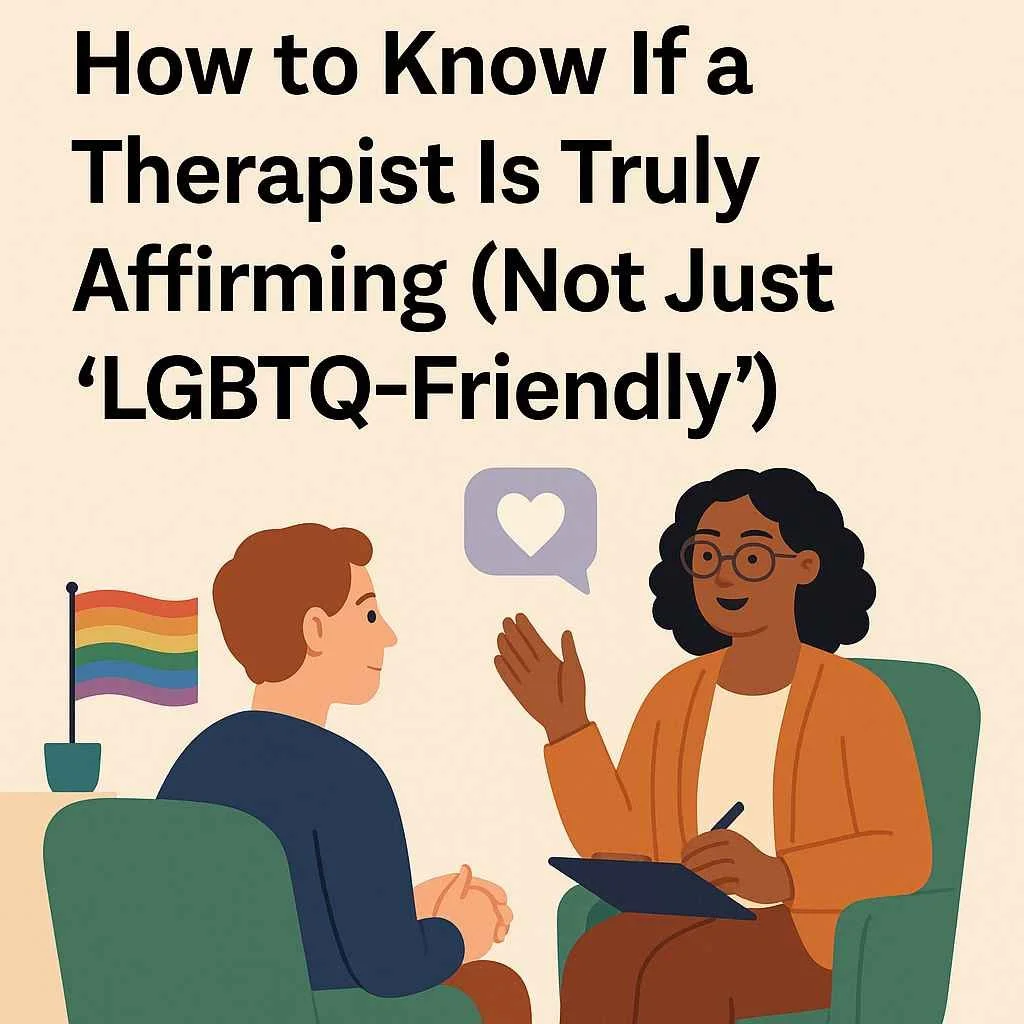
How to Know If a Therapist Is Truly Affirming (Not Just “LGBTQ-Friendly”)
If a clinician validates your identity, integrates minority stress into the case formulation, and adapts methods to your real life (kink/CNM/sex-work context, culture, faith, family), they’re affirming—not merely “friendly.” Use the 15-point scorecard, consult-call script, and red-flag checklist below to vet providers in 15 minutes. If you want a fit-check with a team that practices this standard every day, book a free telehealth consult with Grey Insight (serving CA, CO, AZ, FL, ID, NV, VA & VT).
Read more: LGBTQIA+ Representation in Media and Why It Matters
What does “affirming therapist” really mean? (vs “LGBTQ-friendly”)
Affirming isn’t a vibe; it
’s a clinical stance.
Identity-positive: Names LGBTQIA+/SGM identities as valid and often strengths to leverage in treatment.
Minority-stress aware: Treats stigma, safety, and systemic barriers as central—not side notes.
Context-specific: Understands CNM/poly, kink/BDSM, sex work, chosen family, and cultural/religious dynamics without moralizing.
Power-literate: Names bias and power in the room and, when appropriate, advocates with you in systems (HR, school, insurance).
Consent-forward: Paces therapy with transparent consent for language, exercises, and disclosures.
Bottom line: “LGBTQ-friendly” says “I won’t judge.” Affirming says “I will center your reality and tailor care accordingly.”
Read more: Embracing LGBTQ Identity: A Path to Self-Acceptance
10 green flags vs 10 red flags
Green flags (you’ll hear/see these fast):
Uses your name/pronouns consistently and corrects records when asked.
Intake forms offer more than binary gender and include chosen family/relationship structures.
Says “We integrate minority stress in your case plan.”
Discusses kink/CNM with a consent-safety-agency lens.
Names sex work as complex labor shaped by economics and safety—not a diagnosis.
Asks about faith/culture and religious trauma without pushing “harmony” over your safety.
Harm-reduction stance on substances; no abstinence precondition.
Explains privacy clearly (HIPAA platform, confidential communications on request, psychotherapy notes).
States licensure for your location and verifies it every telehealth visit.
Offers tangible takeaways (skills, worksheets) and revisits goals.
Read more: Safe Spaces Online: LGBTQIA+ Affirming Therapy Resources
Red flags (walk away):
“We don’t need labels.”
Avoids pronouns or “forgets” repeatedly.
Treats kink/CNM as pathology by default.
Frames sex work as inherently harmful or evidence of trauma.
Pressures “family harmony” at the cost of authenticity/safety.
Shrugs at minority stress: “Let’s focus on the individual, not society.”
Vague on privacy or records; can’t explain telehealth security.
Can’t say where they’re licensed or suggests telehealth is “fine anywhere.”
“Therapy is therapy”—no examples of adapting methods to your context.
No plan, no metrics, no homework—just “we talk.”
Read more: LGBTQIA+ Stories That Inspire and Empower Communities
15-Point Affirming Therapist Scorecard (0–2 each)
Score 0 = missing, 1 = partial, 2 = strong.
24–30 = green · 17–23 = proceed with caution · ≤16 = keep looking
Correct name/pronouns + record updates offered.
Intake recognizes nonbinary identities and chosen family.
Minority stress explicitly integrated into the case formulation.
Kink/BDSM discussed consent, safety, and agency.
CNM/poly knowledge (metamours, agreements, jealousy/compersion skills).
Sex-work-affirming practice; separates safety/economics from moral judgment.
Religion/culture explored without forced conformity.
Harm-reduction approach to substances.
Trauma-informed pacing; opt-in consent for exercises.
Privacy clarity (HIPAA platform; psychotherapy vs. medical record; confidential communications).
Licensure is clear for your location; location verified each session.
Collaborative goals and progress measures you agree on.
Tangible takeaways each session (skills, worksheets, scripts).
Transparent fees; superbills/out-of-network support.
Fit-first policy; will refer if not ideal.
Pro move: Paste this list into a notes app and score in real time during your consultation.
Read more: Affirmative Therapy for LGBTQ+ Mental Health Support
Consult-call script: 10 questions + what a strong answer sounds like
Use exact wording. You’re hiring expertise, not vibes.
“How do you define affirming therapy?”
Strong: “We validate identity, integrate minority stress, and adapt CBT/ACT/EMDR to your context—CNM, kink, sex work, faith, culture.”
Weak: “We’re open-minded.”“What recent training or supervision have you completed for LGBTQIA+, CNM, kink, or sex-work contexts?”
Strong: Names CEUs, consult groups, supervisors, and how training changed practice.
Weak: “I have friends in the community.”“How do you handle names, pronouns, and documentation?”
Strong: Updates EHR fields; confirms each session; offers confidential/alternate communications if requested.
Weak: “We’ll try to remember.”“How do you approach religious trauma or family pressure?”
Strong: Validates harm; prioritizes safety; offers boundary scripts and pacing.
Weak: “We aim for family harmony first.”“How do you treat kink/CNM in planning?”
Strong: Consent frameworks; jealousy and compersion skills; agreement audits and calendar logistics.
Weak: “We don’t really go into that.”“What’s your stance on sex work?”
Strong: Values-based, non-moralizing; focuses on safety, economics, and consent; offers digital-safety planning if needed.
Weak: “We’ll process the trauma that led to it.”“How do you protect privacy in telehealth and records?”
Strong: HIPAA platform, separate psychotherapy notes, portal messaging options, clear EOB guidance.
Weak: “We use Zoom.”“Are you licensed to see me where I’m located today?”
Strong: States license(s)/compact, verifies your location each visit.
Weak: “Telehealth is fine anywhere in the U.S.”“What does the first month look like?”
Strong: Assessment → goal map → skills/homework; weekly cadence; check-ins with measurable indicators.
Weak: “Let’s just talk and see.”“How will we know therapy is working?”
Strong: Tracks specific outcomes (sleep, avoidance, relationship stress, panic episodes), reviews data, adjusts plan.
Weak: “You’ll feel better.”
Read more: Compassionate Care: Online Therapy for LGBTQIA+ Adults
How to find an affirming therapist near me (and via telehealth)
Shortlist fast with targeted searches
Use exact phrases: “queer affirming counselor”, “CNM poly affirming therapist”, “kink-aware therapist”, “sex-work-affirming therapy” + your city/state.
Scan About pages for explicit statements on minority stress, kink/CNM, sex work, and harm reduction—not just rainbow flags.
Verify licensure for your location
Telehealth is state-based. You must be seen by someone licensed where you physically are during the session. Ask providers to confirm and to verify your location each visit.
Telehealth vs local office
Telehealth expands access to truly affirming clinicians and preserves privacy. Prioritize fit and expertise over commute—especially if local options are merely “friendly.”
Build a balanced list
Book 3 consults from your shortlist. Score each using the 15-point tool, then choose the highest-scoring fit (or ask for a referral if none exceed your threshold).
Read more: LGBTQIA+ Volunteer Opportunities
Insurance, cost, and privacy—no surprises
Coverage & parity
Many plans cover tele-mental health. Verify network, copay/coinsurance, and whether you can use superbills out of network. A fit clinic will run a benefits check before session one.
EOB and mail privacy
If you share a mailbox or worry about mail/EOB visibility, ask about confidential communications and alternate addresses. Request portal-only messaging when possible.
Records & psychotherapy notes
Ask how progress notes are kept, whether psychotherapy notes are stored separately, and what gets shared for coordination (e.g., with a prescriber) only with your consent.
Transparent fees
Expect straightforward fee schedules, no-surprise policies, and help evaluating whether in-network, out-of-network, or cash-pay is best for your situation.
Read more: How Affirmative Therapy Supports LGBTQ+ Identities
“LGBTQ-friendly” vs affirming—a 60-second comparison
Identity: “We don’t need labels” vs “Your identity is a strength and part of the plan.”
Stigma: “Focus on you, not society” vs “Minority stress is central to treatment.”
Relationships: Monogamy-by-default vs normalized CNM/poly and chosen family.
Sexuality & kink: Pathology frame vs consent-desire-safety-agency frame.
Sex work: Moral judgment vs complexity, safety, and choice.
Religion & culture: Forced harmony vs safety-first, trauma-informed exploration.
Power & advocacy: Neutral observer vs naming bias and, when needed, advocating with you.
Why choose Grey Insight
We practice the standard you’re screening for.
Explicitly affirming across LGBTQIA+, CNM/Poly, Kink/BDSM, and sex-work contexts.
Trauma-informed + harm-reduction with tangible skills every session—scripts, worksheets, and measured progress.
Telehealth done right across CA, CO, AZ, FL, ID, NV, VA & VT with location verification each visit and HIPAA-compliant tools.
Privacy clarity from day one (confidential communications, psychotherapy notes, portal options).
Fit-first policy: If we’re not ideal for your goals, we’ll help you find the right clinician.
Book My Free Consultation (15 minutes). Bring the scorecard; test us against it.
-
A clinician who validates identity, integrates minority stress into your case plan, and adapts methods to your real life (kink/CNM/sex work, culture, faith, family).
-
Use the 15-point scorecard during a consult; ask the 10 questions above; confirm licensure for your location and privacy practices.
-
Friendly table stakes. Choose demonstrable training/supervision in LGBTQIA+, CNM, kink, and sex-work contexts—and a therapist who can show how care changes because of it.
-
Yes—if the provider is licensed where you are, uses HIPAA-compliant tools, verifies location each session, and adapts therapy to your context.
-
Pathologizing identity/kink/CNM; dodging pronouns; “family harmony” over your safety; vague privacy; unclear licensure for your state.
