Polyamory-Friendly Couples Therapy: What Actually Happens in Session
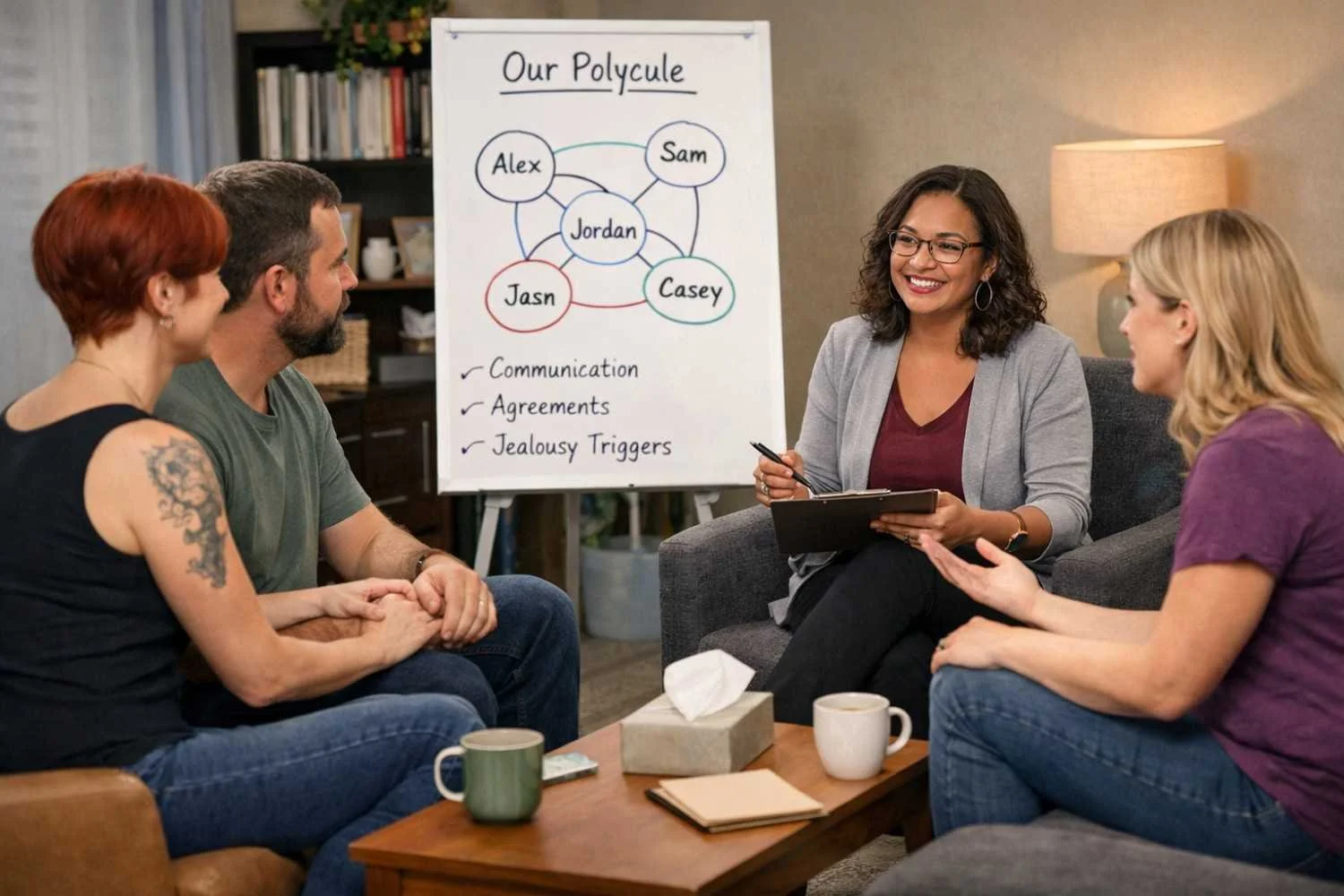
Polyamory-friendly couples therapy is structured relationship therapy for how your system runs—communication, agreements, attachment wounds, jealousy triggers, time/priority conflicts, and repair after ruptures. In session, a clinician helps you map your “polycule reality” (who’s involved, what’s agreed, what’s not working), then builds repeatable tools: how you talk, how you make decisions, how you handle hard feelings without collapsing into blame or control. At Grey Insight, relational therapy can include couples, throuples, and polycules (up to 4 members), and the work starts by analyzing relational foundations and agreement structure so you leave with usable action steps—not just insights.
Read more: Affirmative Therapy in Irvine: A Guide to Healing
1) What “polyamory-friendly couples therapy” actually means
A polyamory-friendly therapist doesn’t treat polyamory as the problem to “fix.” They treat it as the relationship context—like parenting, long-distance, blended families, or chronic illness. The clinical focus is:
Relational foundations: attachment patterns, conflict cycles, rupture/repair history.
Agreements & alignment: what you’re building, what’s allowed, what’s private, what’s shared.
Skills & structure: communication protocols, calendar realities, emotional regulation, decision-making.
Minority stress & stigma: the outside pressure that shapes inside conflict (including shame, secrecy, fear of judgment).
If a therapist keeps pulling you back to “why can’t you just be monogamous,” you’re not in poly-affirming care. Research on CNM clients shows that judgment, pathologizing, or assuming CNM is inherently harmful is experienced as harmful therapy practice—while inclusive, anti-stigma, culturally aware care is experienced as helpful.
Read more: Boost Confidence Affirmative Therapy
2) Who attends session (and why this changes the therapy)
Polyamory-friendly relational therapy can be run in a few formats:
Dyad sessions (two people) Most common: a couple opening up, a primary dyad with outside partners, or a hinge + one partner to work on stability.
Triad / throuple sessions (three people) Helpful when decisions, insecurity, or “two vs one” dynamics keep repeating.
Polycule sessions (3–4 people, sometimes rotating) Useful when the system is stuck: scheduling chaos, conflict spillover, unclear boundaries, mismatched expectations. Grey Insight explicitly offers relational therapy for couples and “throuples (or polycules up to 4 members).”
The non-negotiable: confidentiality rules
With multiple people in treatment, confidentiality gets complex fast. A quality therapist will explain the limits of confidentiality, who the client is (the system vs the individuals), and how information is handled. American Association for Marriage and Family Therapy ethics guidance highlights that in couple/family/group treatment, disclosures outside treatment require written authorization from each individual, and therapists must not reveal one person’s confidences to others in the client unit without permission. Practically: you should expect a clear conversation early on about “secrets policies” and how the therapist handles disclosures that affect the relationship system.
Read more: Understanding Affirmative Therapy and Its Impact on Wellness
3) The Session Roadmap (what happens, in order)
Below is what high-quality polyamory-friendly couples therapy usually looks like. Expect variation by clinician style, but the sequence is remarkably consistent.
Phase 1: Intake & system mapping (Sessions 1–2)
Goal: stop guessing what the problem is.
What happens:
Relationship map: who’s in the system, roles (hinge, nesting partners, long-distance partners), and “who impacts what.”
Your “why” for CNM: opening motivation, values, fears, and non-negotiables.
Current agreements inventory: what’s explicit vs assumed; what’s working vs resentful.
Conflict pattern ID: your recurring loop (pursue/withdraw, blame/defend, explode/avoid).
Risk screen: safety concerns, coercion, untreated trauma, substance use patterns, or unstable conditions that make CNM negotiation unsafe.
Grey Insight describes early work as analyzing relational foundations, attachment and relational development, conflict management, and the interaction patterns contributing to problems.
What you leave with: a shared problem statement (finally), plus 1–2 stabilization actions for the week.
Phase 2: Stabilization (Sessions 3–6)
Goal: reduce volatility so real work is possible.
What happens:
Communication reset: speaking in needs/impact, not accusations; replacing “gotcha” language with clarity.
Jealousy decoding: jealousy as a signal (threat, abandonment fear, status fear, scarcity fear)—not a moral failure. Grey Insight explicitly includes processing jealousy and building insight so it doesn’t ruin the relationship.
Repair skills: what you do after a rupture (apology structure, accountability, rebuilding trust).
Consent culture inside the relationship: you don’t “agree” under pressure—especially during NRE (new relationship energy).
What you leave with: a repeatable “hard conversation” script + a repair protocol.
Phase 3: Agreements engineering (Sessions 6–10)
Goal: replace vague rules with agreements that fit real life.
This is where most people feel the biggest relief—because chaos becomes structure.
What happens:
Boundaries vs rules: boundaries = what I will do; rules = what you must do. Therapy helps you stop confusing control with safety.
Decision-making model: consensus? autonomy-with-notice? veto? time-limited trial agreements?
Meta-communication: how you negotiate the negotiation (timing, tone, consent to revisit).
Grey Insight’s CNM work includes exploring intentions for opening, discussing rules and boundaries, and implementing systems that support weak points in the relationship structure.
What you leave with: a written “agreements draft” and a review cadence.
Phase 4: Integration & growth (Sessions 10+)
Goal: make the relationship resilient, not fragile.
What happens:
Compression work (when appropriate): not forced positivity—more like reducing threat response and building security. Grey Insight explicitly names compressio
n as a therapy goal without sacrificing your needs.
Attachment security: how you signal “you matter” in a multi-partner system.
Long-term maintenance: check-ins, conflict prevention, repair after mistakes.
What you leave with: a sustainable relationship operating system.
Read more: Affirmative Therapy in Irvine: Embrace Your Authenticity
4) The Agreements Ladder (a framework you can literally build in session)
Most polyamory conflict isn’t “jealousy.” It’s unclear agreements + mismatched expectations.
Use this ladder as a therapy-friendly structure:
Values & vision Why CNM? What does “success” look like 6–12 months from now?
Emotional safety agreements How you handle reassurance, aftercare for tough talks, and consent around sensitive topics.
Time & priority agreements Calendaring, holidays, nesting logistics, parenting constraints, and “default time” policies.
Disclosure & privacy agreements What gets shared (and when), what stays private, and how you protect dignity across partners.
Sexual health agreements Testing cadence, barrier use preferences, and how changes are communicated—without shame or policing.
Metamour / community agreements Introductions, parallel vs kitchen-table preferences, event etiquette, and social media boundaries.
Conflict & repair agreements What happens when someone breaks an agreement: disclosure, repair steps, rebuilding trust.
Review cadence Monthly? Quarterly? Trigger-based? Therapy often becomes the container for these reviews until you can self-run them.
This ladder prevents the common trap: making rigid rules for anxiety instead of building flexible agreements for reality.
Read more: Best Practices of Affirmative Therapy
5) What therapy targets that poly people rarely get taught
A strong polyamory-friendly therapist is watching for predictable failure points:
NRE distortion: people over-promise, under-communicate, and minimize impact.
Hinge skill gaps: one person managing two relationships without clear structure.
Scarcity mindset: “If my partner loves them, I lose.”
Covert hierarchy: claiming “non-hierarchical” while time, money, and decisions say otherwise.
Avoidance disguised as autonomy: “I’m independent” becomes “I won’t repair with you.”
Stigma stress: hiding your relationship structure increases tension and misattunement.
Also important: relationship structure alone doesn’t predict relationship quality. A recent meta-analytic review found relationship and sexual satisfaction are broadly comparable between monogamous and non-monogamous people—challenging the “monogamy is superior” assumption. So therapy isn’t about defending your structure. It’s about building skills that make your structure workable.
Read more: Safe Spaces Online: LGBTQIA+ Affirming Therapy Resources
6) What a therapist does that’s actually affirming for CNM clients
CNM-affirming care is not “I won’t judge you.” It’s:
No default moral hierarchy: monogamy isn’t treated as the gold standard.
No pathology shortcut: CNM isn’t blamed for every symptom.
Minority stress awareness: stigma, secrecy, and fear of being “found out” are treated as real stressors.
Systems thinking: therapy works with the relationship network, not just individual feelings.
Concrete tools: agreements, scripts, repairs, decision rules.
If you’re reading this because you’ve had therapy that felt subtly shaming, you’re not imagining it—research on CNM clients documents both harmful and helpful clinician behaviors, and the difference is often whether the clinician uses an inclusive framework vs stigma-based assumptions.
Read more: Affirmative Therapy: A New Approach to Mental Wellness
7) What changes when therapy is online
Online relational therapy changes logistics, not the core work.
What changes:
Privacy planning: headphones, separate rooms, and agreements about who’s present off-screen.
Better scheduling for polycules: easier to gather multiple people, especially across cities/states.
Shorter repair loops: some clients find it easier to do brief, frequent “maintenance” sessions online.
Grey Insight explicitly frames CNM therapy as workable via online therapy and describes the work as building cohesion, processing jealousy, strengthening boundaries, and leaving sessions with practical takeaways.
Read more: Culturally Aware Affirmative Therapy
8) A natural Grey Insight fit
If you want polyamory-friendly relational therapy that treats CNM as valid—not as a symptom—Grey Insight offers affirming therapy for couples, throuples, and polycules, with sessions designed to analyze attachment and conflict patterns, clarify boundaries vs rules, and build systems that make day-to-day life feel steadier.
Consensual Non-Monogamy & Polyamory therapy (service page)
Clinical Consultation (booking/fit call)
LGBTQIA+ affirmative therapy (for SGM clients choosing affirming care)
BDSM & Kink therapy (if your agreements include kink dynamics)
Read more: How to Find a Kink-Aware, BDSM-Friendly Therapist (Without Having to Educate Them)
FAQs
-
It’s relationship therapy designed for consensual non-monogamy. The therapist helps you map your relationship system, clarify agreements, and build communication and repair skills without treating polyamory as the problem.
-
No. Many people start as a dyad, then add partners for specific issues (agreements, scheduling, trust repair). Some practices offer sessions for throuples or polycules up to a set number of participants.
-
Typically: relationship mapping, goals, current agreements, recurring conflict patterns, and a plan for confidentiality—especially important when more than one person is involved.
-
Jealousy is common, but therapy often treats it as a signal pointing to insecurity, unclear agreements, time scarcity, attachment injuries, or fear of replacement—then builds structure and repair skills around those drivers.
-
Boundaries are what you will do to protect your wellbeing (your actions). Rules are what you demand others do (their actions). Therapy helps couples replace control-based rules with clarity-based agreements that respect autonomy.
-
Competent therapists address this upfront using informed consent: what counts as confidential, whether the therapist keeps individual secrets, and how disclosures that affect the relationship are handled. Ethics guidance highlights the complexity of confidentiality when the “client” is more than one person.
-
Research does not support the idea that monogamy is inherently more satisfying. A meta-analytic review found comparable relationships and sexual satisfaction across monogamous and non-monogamous people.
-
Listen for: no shaming, no “monogamy as the fix,” comfort discussing agreements/attachment/repair, and an ability to name stigma as a stressor. CNM client research shows inclusive, nonjudgmental frameworks are experienced as helpful—while pathologizing and moralizing is harmful.