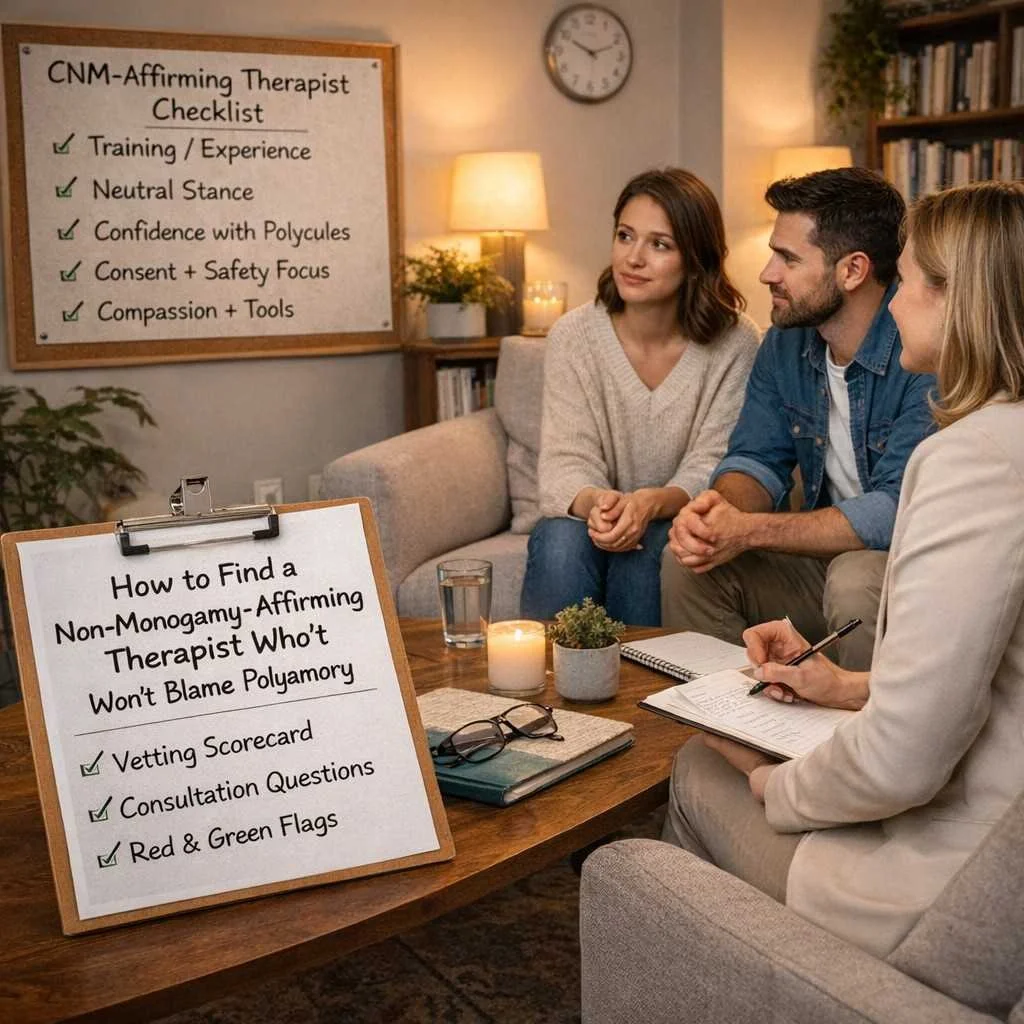
How to Find a Non-Monogamy-Affirming Therapist Who Won’t Blame Polyamory
Consensual non-monogamy (CNM) is an umbrella term for relationship structures where everyone involved explicitly consents to having romantic and/or sexual connections with more than one person. It’s not the same thing as cheating.The problem is that some therapists—often without realizing it—carry mononormative assumptions (treating monogamy as the default “healthiest” outcome). When that bias shows up, polyamory becomes the convenient explanation for everything: anxiety, conflict, jealousy, attachment wounds, even depression—regardless of what’s actually happening.
This guide gives you a clear, practical way to find a CNM-affirming therapist: where to search, how to screen profiles, what to ask in a consult, red flags, and a scorecard to choose confidently.
Read more: Affirmative Therapy in Irvine: A Guide to Healing
The 60-second answer
Search in the right places (CNM-aware directories + broad directories with CNM filters).
Shortlist 3 therapists who explicitly mention CNM/poly/open relationships.
Book brief consults and ask high-signal questions (below).
Score them using the CNM-affirming therapist scorecard (Table 2).
Choose the therapist who treats CNM as context, not a diagnosis.
Read more: Boost Confidence Affirmative Therapy
Why CNM clients get blamed in therapy
There’s a well-documented risk when clinicians hold unexamined assumptions about CNM: they may misinterpret common human experiences (jealousy, uncertainty, conflict) as proof that CNM is inherently unhealthy, rather than exploring the real drivers (communication patterns, agreement clarity, attachment injuries, trauma history, minority stress).
CNM stigma is real, and stigma changes how people experience relationships and care systems. A therapist who isn’t aware of that can unintentionally add shame where you needed support.
What you’re looking for isn’t just “nonjudgmental vibes.” You’re looking for someone who can:
talk about CNM accurately (consent, agreements, ethics),
recognize and correct mononormative bias,
and help you work on the actual problem (communication, boundaries, repair, attachment, trauma, identity).
Read more: Understanding Affirmative Therapy and Its Impact on Wellness
Step 1: Decide what kind of therapy you need (so you don’t hire the wrong fit)
Before you search, choose your “therapy format”:
A) Individual therapy
Best if your goal is:
jealousy regulation
attachment work
trauma processing
shame reduction
identity clarity
B) Relationship therapy (two partners)
Best if your goal is:
agreements (disclosure, time, safer sex)
conflict repair
opening conversations
rebuilding trust after ruptures
C) Polycule / multi-partner therapy
Best if your goal is:
shared agreements across a network
communication norms across multiple relationships
logistics and consent structure
Important: Not every therapist is set up for multi-partner work. You need to ask directly about confidentiality, documentation, and how they structure sessions.
Read more: Best Practices of Affirmative Therapy
Step 2: Where to search (high-signal directories)
Use at least one CNM-specific or CNM-forward directory plus one broad directory for volume.
| Directory | Best for | What to watch for |
|---|---|---|
| Psychology Today (CNM/Open Relationships filter) | Large pool, fast shortlist | Quality varies; you must interview. |
| TherapyDen (Polyamorous & Open Relationships specialty) | Values-forward profiles; strong filters | Still interview; “affirming” should be specific. |
| APA Div 44 CNM resources | Clinician education; definitions | Not a directory, but great for standards. |
| ACA practice brief (CNM counseling) | Clinician-facing best practices | Use to sanity-check therapist competence. |
Tip: In any directory, search for language like: CNM, ENM, polyamory, open relationships, kink-aware, sex-positive, affirmative, minority stress, attachment-based, EFT, Gottman, IFS, EMDR — then confirm with a consult.
Read more: Safe Spaces Online: LGBTQIA+ Affirming Therapy Resources
Step 3: How to read therapist profiles (fast screening)
Look for specificity, not labels.
High-signal profile indicators (green flags)
Mentions CNM/ENM/poly/open relationships explicitly (not just “non-traditional”)
Describes how they work with CNM issues (agreements, disclosure, jealousy tools, repair)
Names relevant training or modality and how it applies
Speaks neutrally: CNM is a structure, not a symptom
Low-signal indicators (yellow flags)
“Open-minded” with no CNM detail
“I work with couples” but only monogamy-coded language
Heavy moral framing (“commitment issues,” “fear of intimacy”) without assessment
Read more: Affirmative Therapy: A New Approach to Mental Wellness
Step 4: Ask questions that reveal bias quickly
Most competitor articles give “nice” questions. You want diagnostic questions—ones that force the therapist to reveal assumptions. (This approach is also echoed in competitor guidance: listen for specific experience, not just openness.)
| Question to ask | Green-flag answer sounds like | Red-flag answer sounds like |
|---|---|---|
| “What experience and training do you have with CNM clients?” | Specific examples, steady neutral tone, ongoing learning | “I’m open-minded” with no detail |
| “How do you avoid assuming monogamy is the solution?” | Names mononormativity/bias; focuses on goals you choose | “Monogamy is healthiest” or “You’ll grow out of this” |
| “How do you work with jealousy in CNM?” | Normalizes jealousy; offers tools + agreement work | Treats jealousy as proof CNM is wrong |
| “How do you handle agreement design (disclosure, safer sex, time)?” | Talks about collaborative agreements and repair | Pushes controlling rules or moralizes |
| “Have you worked with polycules? How do you handle confidentiality?” | Clear policy, consent, structure, documentation awareness | Avoids the question or assumes dyad-only |
| “If anxiety/depression is the issue, how do you avoid blaming CNM?” | Explores stressors, attachment, stigma, coping | Defaults to “CNM causes instability” |
Step 5: Use a scorecard so you don’t choose on vibes
Score each item 0–2 (0 = no, 1 = partial, 2 = clearly yes).
| Criteria | What “2 points” looks like | Score (0–2) |
|---|---|---|
| CNM competence (not just openness) | Can describe CNM work (agreements, jealousy tools, repair) | |
| Bias awareness | Explicitly rejects monogamy-as-default; names mononormativity | |
| Consent-first framework | Clear respect for autonomy + consent across partners | |
| Multi-partner readiness (if needed) | Has a plan for structure/confidentiality, not dyad-only | |
| Clinical skill and goals | Can name a plan + modality fit for your problem | |
| You feel respected | Curious, non-shaming, doesn’t pathologize structure |
-
It means the therapist treats CNM as a valid relationship structure and doesn’t assume monogamy is the goal.
-
No. Openness is attitude; competence includes accurate language, experience, and tools.
-
A cultural bias that privileges monogamy as the default and often “best,” which can distort therapy if unexamined.
-
If they treat CNM as the cause by default and repeatedly steer toward monogamy without assessment.
-
Start with a CNM-filtered directory like TherapyDen, then expand to broader directories and interview.
-
Ask about CNM experience/training, jealousy approach, and how they avoid assuming monogamy is the solution.
-
No. Jealousy is common and workable; what matters is regulation, agreements, and repair.
-
Sometimes. Ask directly about structure and confidentiality.
-
Not necessarily—unless sexual functioning, sexual trauma, or complex consent dynamics are central. The key is CNM competence.
-
That may signal bias. Closure can be a choice, but it shouldn’t be the default prescription.
-
Yes. If you feel judged or misunderstood, switching is ethical self-advocacy.
-
Use a short script: “I’m looking for more CNM-specific experience. Thank you for your time.”
-
That’s a value conflict worth addressing directly. A neutral therapist should help you clarify goals, not pre-decide the outcome.
-
Ask the therapist how they handle privacy, documentation, and communications.
-
You feel respected, the therapist asks about agreements/structure without judgment, and you leave with a clear plan.